Mala Baliraj
Chairperson, Energy Chamber of T&T
Feature Address at the T&T Energy Conference
A Good Morning to all.
On behalf of the Board and Staff of the Energy Chamber of Trinidad & Tobago, I bring salutations, to Members of the Diplomatic corp, Members of the Board, Representatives of our Sponsor members, Members of the Energy Chamber, Members of the Media, ladies and gentlemen.
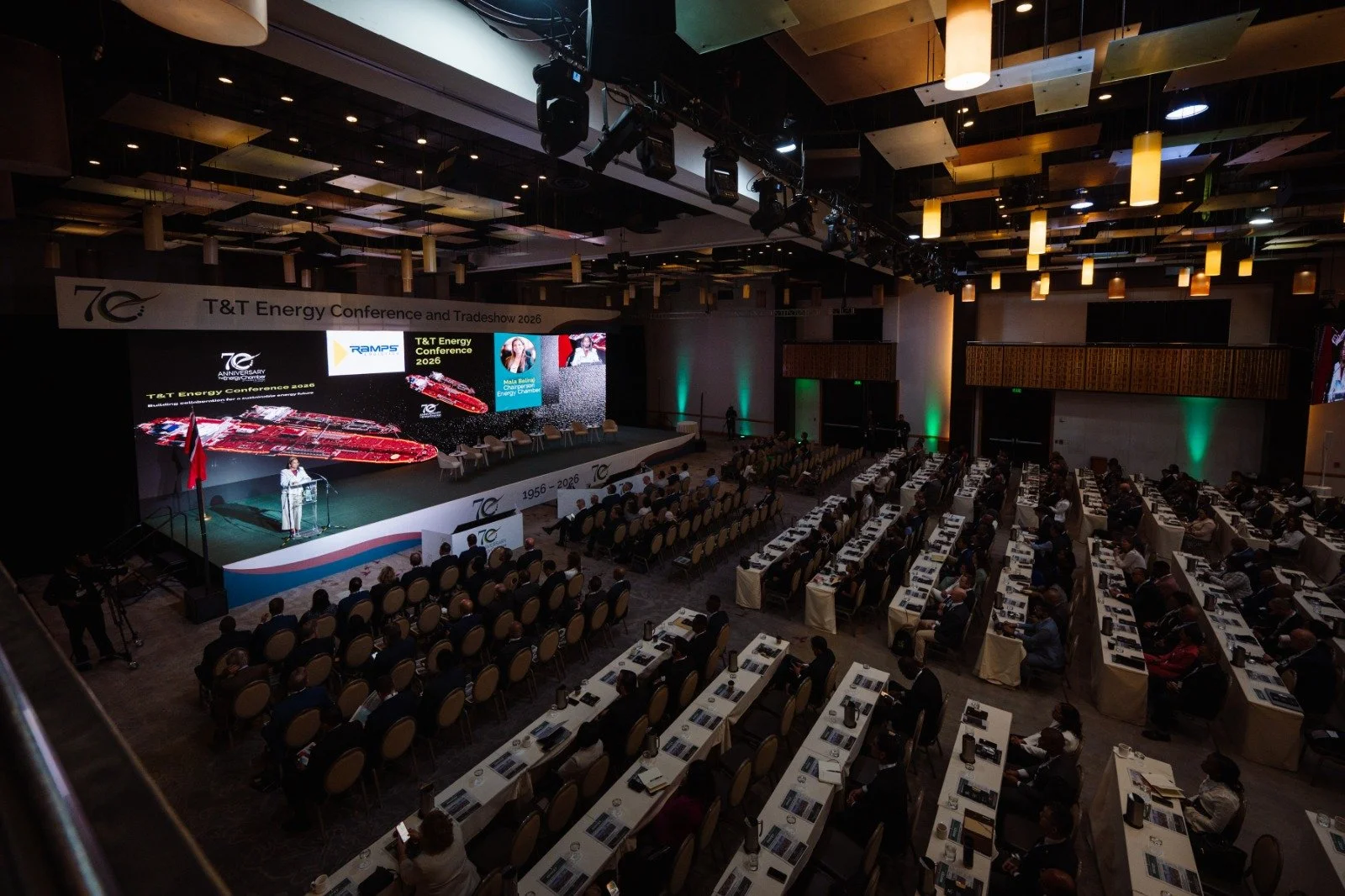
It gives me great pleasure to welcome you to the Trinidad & Tobago Energy Conference 2026. This year marks, the 70th anniversary of the Energy Chamber of Trinidad & Tobago. On this significant anniversary, we acknowledge those men and women of energy, on whose shoulders we stand. As many of our energy pioneers, have contributed significantly to the sector, and national development, through the Chamber, over the years.
As we start the conference this morning, it is imperative that I take the opportunity to address recent events. Last week, The Honourable Prime Minister, announced her position on the Safe To Work programme (STOW) with a decision, to withdraw support for the Conference, along with the withdrawal of state-owned industries participation.
We got some tough feedback. And I will state, that in the spirit of constructive feedback, we have listened to the message. We have committed to reflect, review, and make changes as needed. Our intention, is always to work towards a collaborative approach with all of our stakeholders. As such, we hope to be able to reposition and create a space for open and structured engagement with the Government that supports the best outcomes for the sector. As we have listened, we seek to improve. I am confident there will be better outcomes for all. The Chamber is committed, to doubling down efforts, to work with all stakeholders.
We place the intention, that over time, we can return to a situation in which state enterprises, Ministry of Energy officials, and other state players can participate in this valuable space, to engage with industry on the critical issues we face collectively. We have always valued their participation and contributions, and we hope for the opportunity to welcome them back.
It is not practical for me to use this platform to address all of the issues raised in the last week, but I do want to acknowledge them and to assure you that we will address the specific concerns, through the appropriate channels in a constructive and respectful manner.
However, there are three issues that go to our fundamental purpose, and the Board believes it is our duty to bring some clarification here.
Firstly, the Safe to Work programme, which the Energy Chamber administers on behalf of the energy industry, is a clear point of contention. Some stakeholders do not believe that the Safe to Work programme is meeting its original intent, to both improve safety standards and, to facilitate the ability of smaller local contractors to pre-qualify with major operator companies. It has at time,s served as a barrier to their ability to do business with major operators. We note that, and acknowledged same in the 2025 Chairperson’s opening speech, where the concern of cost associated with consulting advice and training of staff for certification was highlighted with the aim of resolving.
Given the clear position of the Honourable Prime Minister and Minister of Energy, the current configuration of contractor safety management certification and contractor pre-qualification will not be maintained in its current construct. As an industry representative board, the commitment is made, to find, what is the forward step.
What comes next for contractor safety management and certification must be built on the best elements we have as an industry, and improve the areas, that do not work well. This is best achieved through a consultative process, and we commit to our membership to be active participants in crafting a workable solution.
This Board and staff are passionate, that the priority we place on safety management must not, diminish. Our industry needs robust, high‑quality safety practices to be maintained. This is not a theoretical issue, but a day‑to‑day operating reality for every human that we have, at every site and asset, in the sector. Across our industry –for ALL our operators, maintaining high safety levels is not optional; it is simply how business has to be done. Any discussion of safety, centres on protecting lives and ensuring that all those who work in our world‑class energy facilities, return home to their families at the end of every day or shift, as they came. So, this begs, that immediate focus be put into, what happens now.
Secondly, we have heard the view that the Energy Chamber is dominated by multinationals and a handful of larger local members. We hear this perception, and it is understandable where that might come from, but I take the opportunity to clarify. The membership of the Energy Chamber is varied and includes every ownership structure. Among the roughly 400 members the range is from huge global corporations to micro‑enterprises and everything in between. In order to guard against the dominance of one set of interests over another there is a robust, transparent governance framework, that ensures a diverse Board, that reflects this breadth of membership.
Given the current perception, we clearly have to do better. We need to ensure that the perception is not, in fact, driven by reality. So, to ensure that the perception does not persist, we will review our internal governance to re-commit to fair and balanced representation with broad-based engagement of our membership, and critical external stakeholders.
Thirdly, I want to reinforce the aim of this conference, as it has come under question. The conference’s main purpose has always been to create a space, one time, every year, when the Trinidad & Tobago energy industry players come together. It is meant, to give us an atmosphere where we can discuss the issues that impact us all, see the ways we can work together, and kindle new networks and opportunities, for our businesses. I dare say, some have come to believe, that you can get a quick sense, of the health-check of the local energy sector by the “vibe” of the Conference.
We always intend, that while the conversations on this stage are important, so too are those in the trade show, around the lunch tables, and at the receptions. These interactions are meant to strengthen the relationship building, so as to support the resilience of our industry. I do hope that those intentions are fulfilled for all this year as well.
I now beg your indulgence, to permit me to turn to our exciting agenda for the next few days, with the Theme – Collaboration.
At this 2026 conference, we have a strong lineup of speakers, and I am pleased to see so many new delegates and sponsors for the conference: I believe about a third of our 29 sponsors are new. Thank you for your participation.
At the last year’s conference, the Chamber presented a map, outlining the major activities ongoing in Trinidad & Tobago’s energy sector.
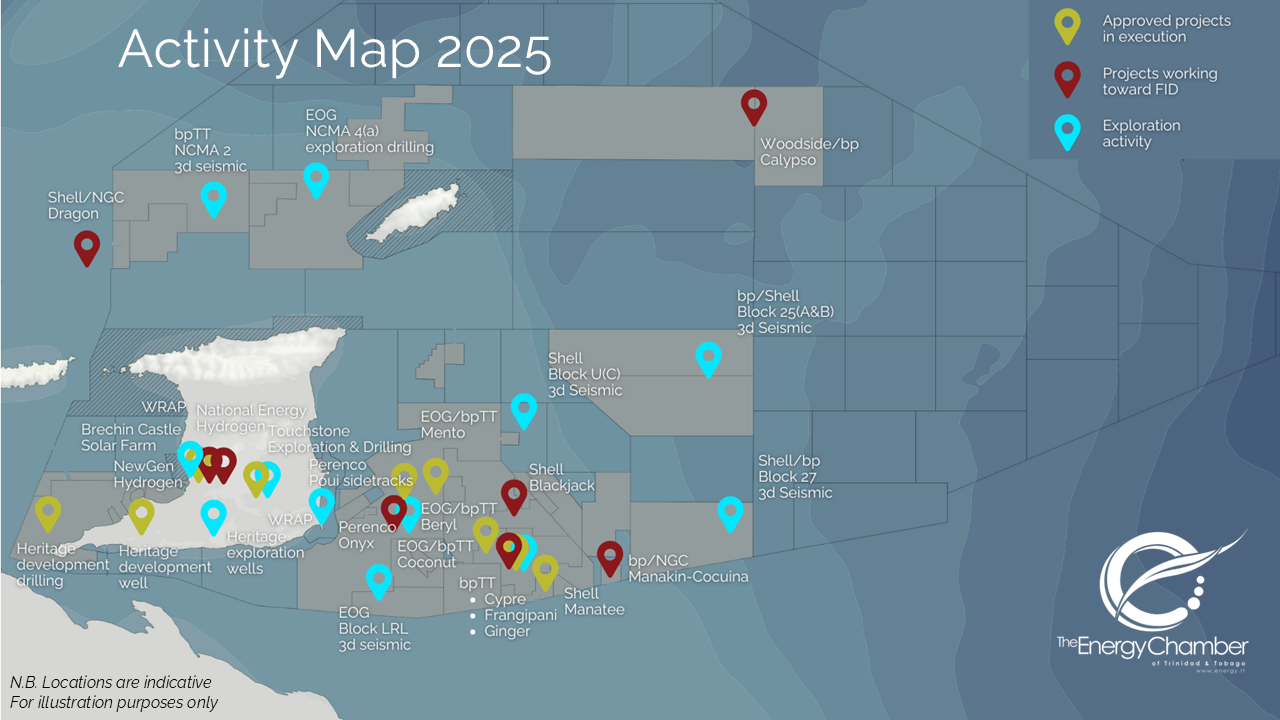
This became quite the reference point, and I think, it gave a sense of confidence to many, both within and outside the sector, that the sector was perhaps more resilient, given the number of major projects in execution. One year on, there are some notable changes worth highlighting.
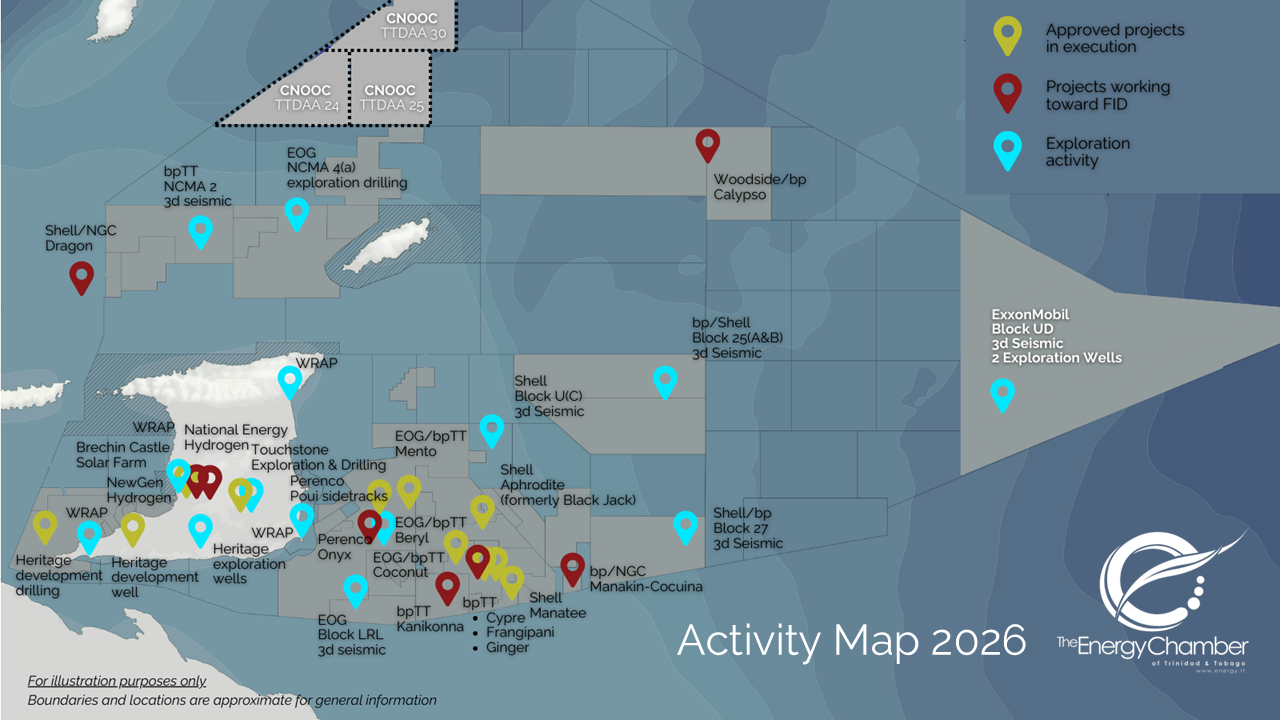
The most obvious change is the licensing of an extremely large new exploration block in the deepwater to Exxon. Given Exxon’s unprecedented success across the maritime boundary in Guyana, this has understandably raised significant renewed global interest in Trinidad & Tobago. We have also seen the entry of another global player, China National Offshore Oil Corporation -CNOOC, into Trinidad & Tobago’s deepwater with bids on blocks TTDAA 24, 25 and 30. We hope those bids will move forward, into an active exploration campaign soon.
We have seen some projects being completed and moving to begin production, notably the bpTT Cypre project and the EOG/bp JV, Mento project. Trinidad’s first grid scale renewables project, the Brechin Castle solar farm, also began producing green electrons in 2025. This is the biggest solar plant in the English-speaking Caribbean and I just want to note that advocacy from this Chamber played an important role in getting the project approved.
In 2025, we have also seen projects that we had listed as being in the FID category “working towards a final investment destination”, moving into the execution phase with, FID having been taken, notably, Shell’s Aphrodite project.
These projects, join others, already in execution and working towards first production. These include the EOG/bpTT Coconut project, which is in execution with the platform being constructed in the TOFCO yard. And bpTT’s fourth subsea project, Ginger, also on schedule to deliver first gas in 2027. The biggest project in execution, is the Shell Manatee, set to come onstream at the end of the 2027. By all reports, execution of these major projects are all proceeding as planned: important news for the downstream gas industry.
It is not, however, just major exploration campaigns and development projects that are needed to secure future oil and gas. It is also the continued reinvestment in existing producing fields, the workovers and production optimisation interventions, the maintenance of facilities, and the equipment reliability interventions needed, to maintain and increase production. The sale of mature producing assets by bpTT and Woodside to Perenco is worth noting in this regard, given Perenco’s expertise in the efficient operation of mature fields. The sale of producing assets, is sometimes portrayed negatively in the press, when it should be seen as positive: a new company with a different skill set, and strategic focus, is willing to invest in continued production.
In addition to the major projects in execution, there are other offshore projects that are still in the category of working towards an FID, which we hope will soon progress into active execution. These include:
· The Woodside/bp Calypso deepwater gas project,
· bpTT’s Frangipani and Kanikonna project,
· Perenco’s Onyx field, and
· another EOG/bp joint venture, Beryl.
Getting investment decisions made, on these and other upstream projects, remains the most important element to secure the future of Trinidad’s energy sector. In recent months, we have seen the Minister of Energy place a firm focus on accelerating approvals in the energy sector, culminating in the welcome news of the Cabinet’s decision to establish an oversight committee, the Energy Accelerator Hub. It is heartening to see a focus placed on this area and aligns with our advocacy position over the years. The Energy Chamber remains fully committed to working with the government on that process.
In addition to accelerating the approvals process, other changes could help investment decisions be made, for some of the discovered but undeveloped fields. Fiscal reform remains an essential element for some fields, especially small and marginal gas fields where a tiered approach may be required. These are policy decisions within Trinidad & Tobago’s control, and we look forward to productive dialogue on these with the relevant stakeholders.
There are two projects listed on this map, where the major factor delaying execution is beyond Trinidad & Tobago’s direct control, namely the Shell/NGC investment in the Dragon field in Venezuela and the bp/NGC investment in the Manakin/Cocuina cross-border field. Recent changes in Venezuela, might offer new hope that these two projects can move toward implementation.
These two projects also need to be seen in a wider context. Venezuela holds massive gas reserves, somewhere in the region of 200 trillion cubic feet. Many of these are in non-associated gas fields, in the east of the country, including offshore in both the Patao, Mejillones, Río Caribe, and Dragón complex to the northwest of Trinidad and the Plataforma Deltana area, off Trinidad’s southeast coast. These resources, are close to existing Trinidad gas infrastructure, and from a pure economic and technical point of view, it just makes excellent sense for both Trinidad and Venezuela, to use Trinidadian infrastructure, to bring that gas to international markets, as LNG or petrochemicals.
Given that, these eastern Venezuelan gas fields, are mainly offshore and close to existing service ports, and logistical infrastructure in Trinidad, the hope is that, the Trinidad service sector could play an important role in supporting their development. The concept of Trinidad being a regional energy hub is one that the Energy Chamber fully supports.
In addition to the non-associated gas fields, there are also huge volumes of natural gas currently flared, on Venezuela's oil fields: as much as 2 billion cubic feet per day is flared. This represents more than the gas shortfall that has so negatively impacted the Trinidad downstream industry, over the last decade. This is a massive economic waste and environmental disaster, and the size of the problem will only grow if Venezuela’s oil production increases with the reentry of US and other international companies.
Capturing, compressing and productively using these gas molecules, will be a major technical and engineering feat, but the global oil and gas industry, is well placed, to find economic and engineering solutions to these sorts of problems. And with the existing Trinidad infrastructure and a downstream industry, willing to pay competitive gas prices, this could be a crucial component to finding a solution.
The downstream gas industry, has faced a highly challenging environment, with gas shortages persisting for over ten years. While there is optimism ahead, driven by projects like Manatee and others in progress, as well as potential future developments in deepwater fields or across maritime boundaries, the sector, still faces immediate difficulties. These challenges, have significantly affected our members in contracting and service companies. It is crucial for the industry, to unite, and prepare to capitalize on upcoming opportunities.
In that regard, we would like to highlight, that businesses in this sector need stable, predictable cost structures if they are to plan investment, maintain employment and stay competitive.
On Day 3, the Local Content Forum takes place. This members-only free event will focus on how the industry can protect, and strengthen our local services sector and the skilled labour force of which we are rightly proud. This is a good opportunity for some of our mid-career professionals and young leaders to get involved in the discussions.
I would also like to note the role, that the energy sector plays, in economic diversification. I highlight in particular, the linkages between the energy and maritime sectors. There is a panel tomorrow morning, looking at the development of a low carbon fuel bunkering industry in Trinidad, taking advantage of our geographical location, our natural sheltered harbours and the availability of LNG, methanol and ammonia, three of the key low carbon fuels for the marine sector.
My last point, but my no means the least, is that the Energy services entities play a key role in the success of our energy industry. The building of our workforce capability and capacity in Trinidad & Tobago directly impacts our service sector. There is a need, to focus on the frameworks we have in the industry, to support this capability building and apply innovative thinking to achieve the capacity needed. We constantly compete globally and regionally to retain our skills and knowledge workforce in country and that requires an enduring approach to training and development in order to succeed. The Chamber holds strongly its commitment, to supporting that learning and development structures, that are needed.
With that, I have come to the end.
Now, I encourage you to have a fantastic conference. Engage in all the discussions, events, and activities planned for you. I hope to see many of you at the Savannah, bright and early Wednesday morning, for the 5K Energy Run/walk.
I must say, Thank you being here today. It has been my privilege, to share these thoughts, on behalf of the Board of the Energy Chamber. Thank-you for your time and attention. We look forward, to engaging with many of you, over the next few days.
WELCOME to the Trinidad & Tobago Energy Conference, 2026.