
Guyana’s temporary fuel shortage this month was a reminder that oil production and fuel security are not the same thing. Newsroom Guyana reported that the disruption left motorists questioning how shortages could emerge in one of the world’s fastest-growing oil producers, before the government said new shipments were on the way and urged the public not to panic buy.
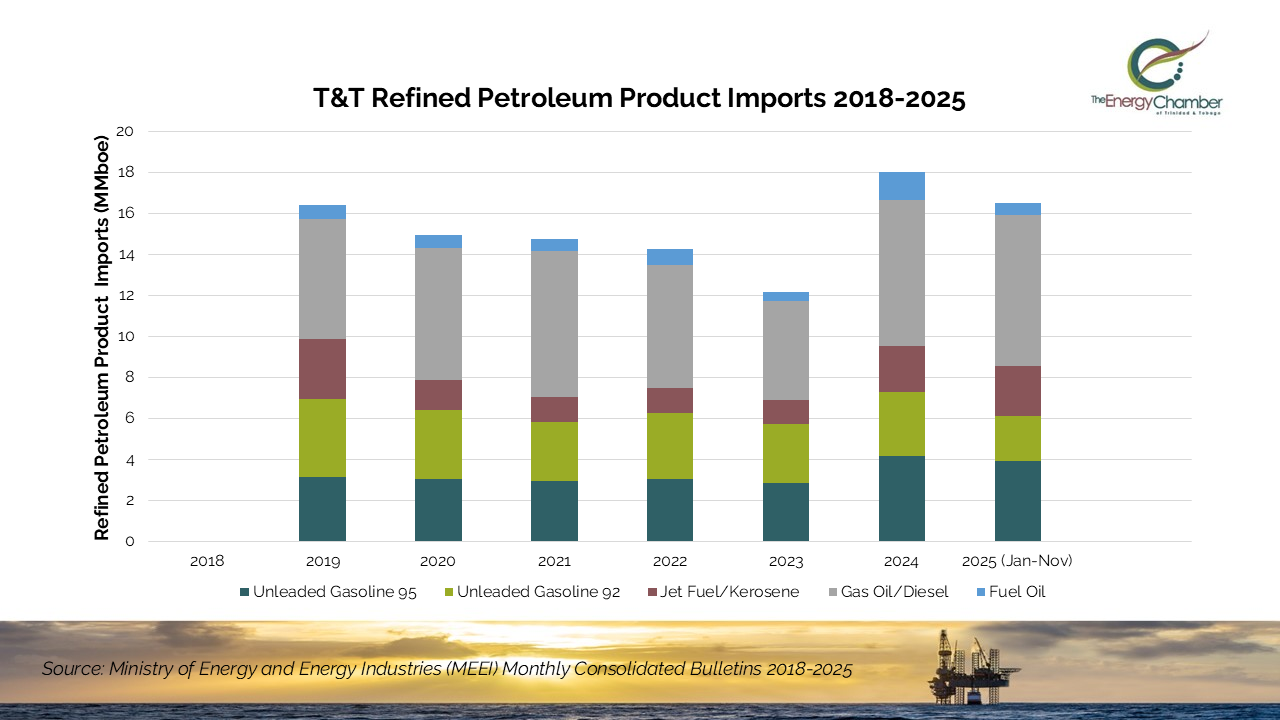
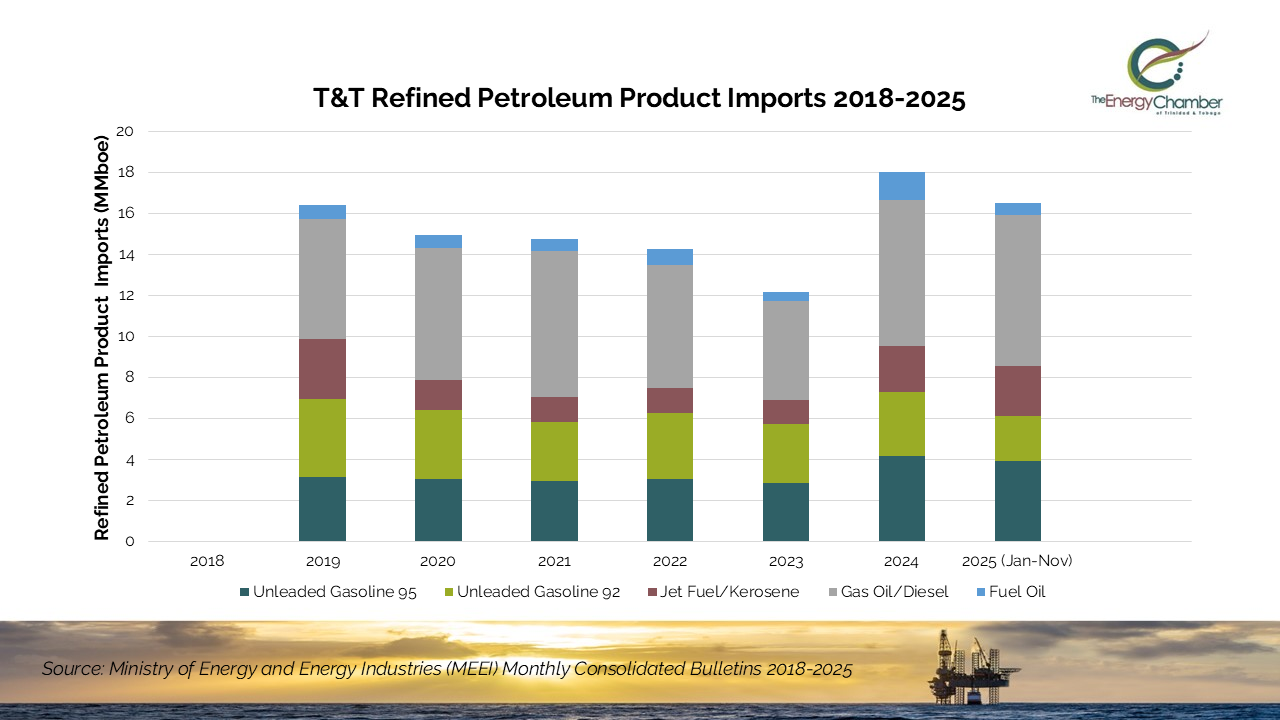
That has relevance for Trinidad and Tobago. The accompanying chart, based on Ministry of Energy and Energy Industries monthly bulletins, shows that the country has continued to import sizeable volumes of refined petroleum products since the refinery closure. Rather than showing a single rising trend, the chart points to persistent dependence across several product categories, especially gas oil/diesel, with gasoline imports also remaining significant. Imports eased between 2019 and 2023, a period that broadly coincided with the economic disruption caused by the COVID-19 pandemic, when restrictions on movement, weaker economic activity and reduced aviation demand softened fuel consumption. By 2024, however, imports had risen again, suggesting that the earlier decline was not simply a story of lower dependence, but also one shaped by temporary demand conditions.
The structural change began in 2018, when Petrotrin announced that refining operations would cease. Reuters reported on August 28, 2018, that the shutdown was linked to recurring losses and the cost of importing crude to keep the refinery operating. At present, the government is exploring options for reopening the refinery.
In the meantime, the country’s fuel security rests on the strength of its import and storage system. The State Enterprises Investment Programme for 2026 says Paria Fuel Trading Company’s main focus is to ensure a continuous supply of fuel for the nation’s use, and it also notes that the completion of Tanks 68 and BS11 is expected to provide additional gas oil tank storage in fiscal 2026. That is a constructive sign: even without refining, investment in storage and terminal reliability can strengthen resilience.
In the meantime, the country’s fuel security rests on the strength of its import and storage system. Paria Fuel Trading Company plays an important role in that system by supporting the storage and distribution of imported fuels. In an import-dependent model, that storage capacity is an important part of supply resilience.
Import dependence also means exposure to conditions outside Trinidad and Tobago’s control. Trade data from the Observatory of Economic Complexity (OEC) show that the United States remained Trinidad and Tobago’s main source of refined petroleum in 2024, accounting for about US$1.14 billion of imports, well ahead of other suppliers. That concentration is not unusual for the region, but it does mean that developments in U.S. Gulf Coast product markets are especially relevant for Trinidad and Tobago.
That is where the Guyana comparison becomes useful. Guyana’s shortage was described as temporary and linked to shipment timing, not a collapse of the system. Even so, it showed how quickly a supply issue can become visible in a market that relies on imported fuels. For Trinidad and Tobago, the lesson is not that a similar event is imminent, but that fuel security in an import-based system depends on more than having enough hydrocarbons in the ground. It depends on inventories, procurement, shipping reliability, storage capacity, and the speed at which supply can be replenished.
The wider international environment has made those considerations more important. UNCTAD said on 1 April that traffic through the Strait of Hormuz had fallen from around 130 ship transits per day in February to just six in March, describing the route as a critical artery for global energy trade. Reuters also reported on 9 April that disruptions linked to the Iran war were boosting U.S. Gulf Coast refining margins as demand for U.S. fuel exports increased. For an importer like Trinidad and Tobago, that does not necessarily translate into a physical shortage, but it can mean higher landed costs, tighter product markets, and greater competition for cargoes.
This is why the discussion around Trinidad and Tobago’s fuel imports is best understood as a resilience issue rather than simply a trade statistic. The chart does not suggest a crisis. It suggests a structural reality: since refining stopped, Trinidad and Tobago has relied on imported fuels supported by storage and distribution infrastructure. That model can work, and with sensible investment in tanks, terminals and supply planning, it can work well. But it also means the country remains exposed to external supply shocks in ways that deserve continued attention.
The encouraging point is that this exposure is manageable if it is treated as a strategic policy issue. Additional storage, strong inventory management, diversified sourcing, and continued improvements at Paria can all help reduce vulnerability. And if discussions on refining move forward on commercially sound terms, that could eventually add another layer of flexibility. For now, however, the main takeaway from both the chart and the Guyana episode is straightforward: in today’s market, fuel security is not just about producing energy. It is about building a system that can absorb disruption and continue to serve the domestic economy reliably.