
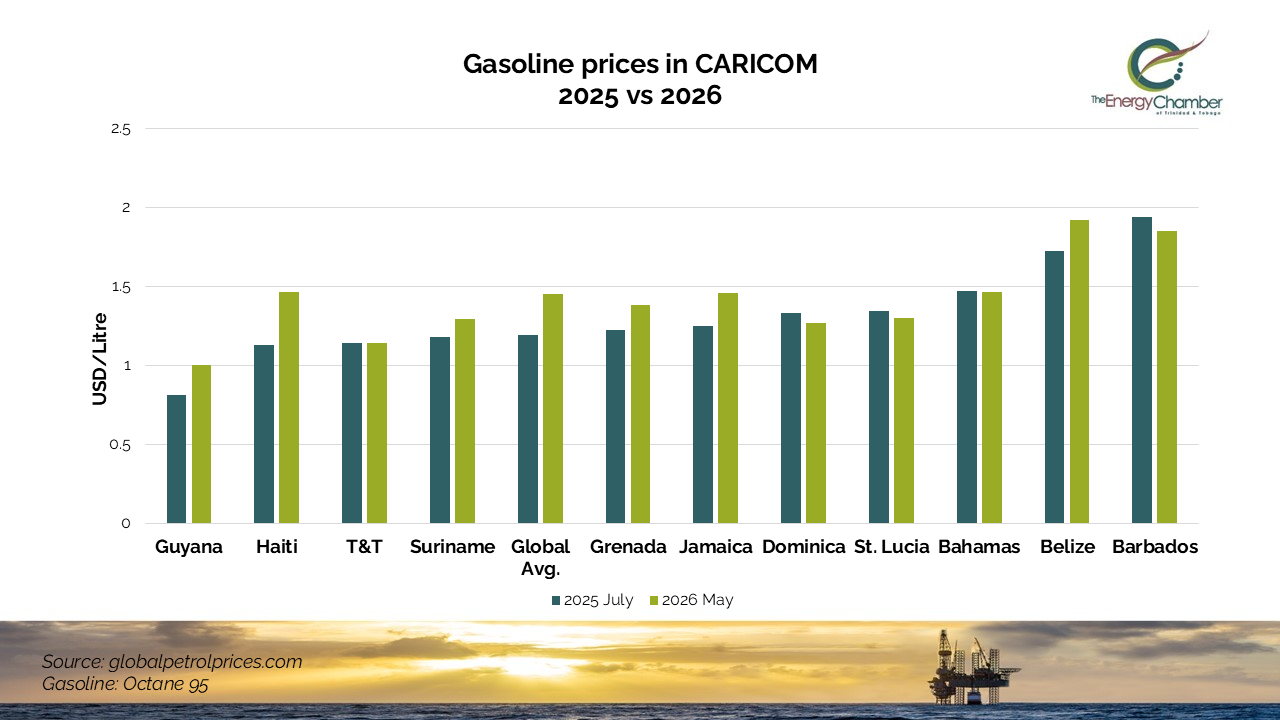
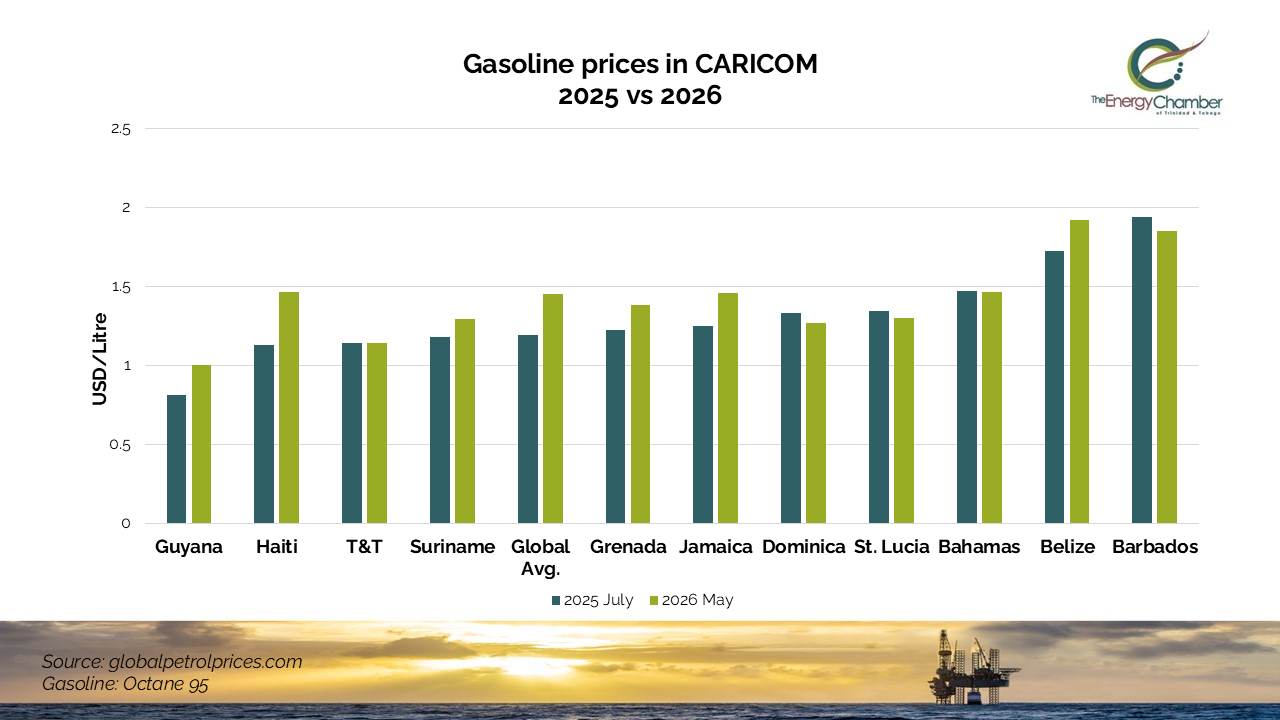
Gasoline prices increased across most CARICOM markets between July 2025 and May 2026, although the average rise across the region was smaller than the increase in the global average price.
Data from GlobalPetrolPrices.com was compiled to show that seven of the eleven CARICOM markets reviewed recorded higher gasoline prices in May 2026 than in July 2025. Four markets recorded lower prices, although in the case of The Bahamas the decline was marginal.
The average gasoline price across the CARICOM markets reviewed rose from US$1.32 per litre in July 2025 to US$1.41 per litre in May 2026. This represents an increase of around 6.9%. By comparison, the global average in the dataset rose from US$1.19 per litre to US$1.45 per litre, an increase of around 21.8%.
Recent volatility around the Strait of Hormuz has added upward pressure to international oil and gasoline prices. Reuters reported in late April that US pump prices were near a four-year high, with gasoline prices climbing more than 40% since late February, as the Iran conflict disrupted oil markets and refinery outages tightened supply. AP also reported that US gasoline prices climbed 31 cents in one week to US$4.54 per gallon, 52% higher than before the Iran war began, according to AAA data. The situation has remained volatile, with oil prices reacting to renewed clashes near the Strait of Hormuz, ceasefire uncertainty and market expectations around whether supply routes would remain disrupted or reopen fully. For CARICOM, this matters because higher crude prices eventually feed into imported fuel costs, although the final price at the pump depends on how each country manages taxes, subsidies, fixed pricing and regulated pass-through mechanisms.
Among the CARICOM markets where prices increased, the average increase was 14.9%. This suggests that while the region was not insulated from higher international prices, government pricing policies, subsidies, taxes and regulated pricing mechanisms helped moderate the impact in several markets.
Haiti recorded the largest increase, with gasoline prices rising from US$1.13 per litre in July 2025 to US$1.46 per litre in May 2026. This was an increase of 29.5%. Guyana recorded the second-largest increase, moving from US$0.81 per litre to US$1.00 per litre, an increase of 23.5%. Despite this increase, Guyana remained the lowest-priced market in the CARICOM sample.
Jamaica’s gasoline price rose by 16.8%, from US$1.25 per litre to US$1.46 per litre. Grenada increased by 13.1%, Belize by 11.6% and Suriname by 9.3%.
Trinidad and Tobago’s price remained largely unchanged, maintaining a gas price of US$1.14 per litre from July 2025 to May 2026. This reflects the country’s fixed pump pricing system, where the retail price is set and the fuel subsidy mechanism absorbs the difference between the wholesale price and the fixed retail price when necessary.
The 2025 to 2026 Budget also included a TT$1 per litre reduction in the price of Super gasoline, announced by the Honourable Davendranath Tancoo, MP, Minister of Finance, during the Budget presentation in October 2025.
Barbados remained one of the highest-priced markets in the region, although its gasoline price fell from US$1.94 per litre in July 2025 to US$1.85 per litre in May 2026. This represents a 4.6% decline. The decrease aligns with a wider fuel relief package announced in Barbados’ 2026 to 2027 Budget. The package included a temporary BBD $0.10 per litre reduction in excise tax on gasoline and diesel for three months, with the gasoline excise tax falling from BBD $0.99 to BBD $0.89 per litre. VAT caps were also kept in place for gasoline and diesel until March 31, 2027, limiting the extent to which high international fuel prices would raise VAT collections at the pump. In addition, Barbados National Energy Company Limited was expected to halve its loss recovery fee from BBD $0.09 to BBD $0.04 per litre, while the Government also committed to absorbing 50% of any increase in the Fuel Clause Adjustment on electricity bills for three months. Together, these measures were designed to deliver a cumulative reduction of BBD $0.15 per litre at the pump and cushion consumers from high global energy prices.
Saint Lucia also recorded a decline, with gasoline prices falling from US$1.34 per litre to US$1.30 per litre, a 3% decrease. The Government of Saint Lucia said it continues to cushion the impact of global oil price volatility through targeted subsidies and applies a modified market pass-through petroleum pricing mechanism. For the April 20 to May 10, 2026 period, gasoline was unchanged at EC$3.52 per litre, while the government continued subsidies on other petroleum products to protect households and key sectors from external shocks.
Dominica’s gasoline price fell by 4.5% in the dataset, from US$1.33 per litre to US$1.27 per litre. Available public reporting points to regulated fuel pricing, rather than a clearly identified new 2026 tax cut, as the main mechanism shaping prices. In March 2026, Dominica announced new regulated fuel prices in response to global market volatility, with gasoline set at EC$15.57 per gallon. Officials noted the vulnerability of small island states to external oil market shocks and the need to manage domestic prices in a balanced way.
The Bahamas was also effectively flat, moving from US$1.47 per litre in July 2025 to US$1.463 per litre in May 2026. This was a marginal decline of 0.5%. Public reporting in April 2026 suggested that Bahamian pump prices were facing upward pressure from global oil market conditions, with gasoline ranging from around US$5.50 to more than US$6.50 per gallon depending on the station and grade.
The 2026 data therefore show two important trends. First, gasoline prices rose in most CARICOM markets, in line with the broader increase in global prices. Second, the average regional increase was much smaller than the global increase, reflecting the influence of domestic policy choices, including regulated prices, subsidies, excise tax changes and VAT caps.
In our previous article, “Gasoline Prices in the Caribbean,” published on Energy Now in 2025, it was noted that gasoline prices across the Caribbean differ widely because pump prices are shaped by crude oil costs, refining, marketing, distribution, transportation, taxes and subsidies. Some countries pass through international price changes more directly, while others use fixed pricing or subsidies to limit consumer exposure.
That remains the key explanation for the 2026 comparison. CARICOM consumers are exposed to the same global oil market, but the price at the pump depends heavily on how each government manages taxes, subsidies and regulated pricing.