
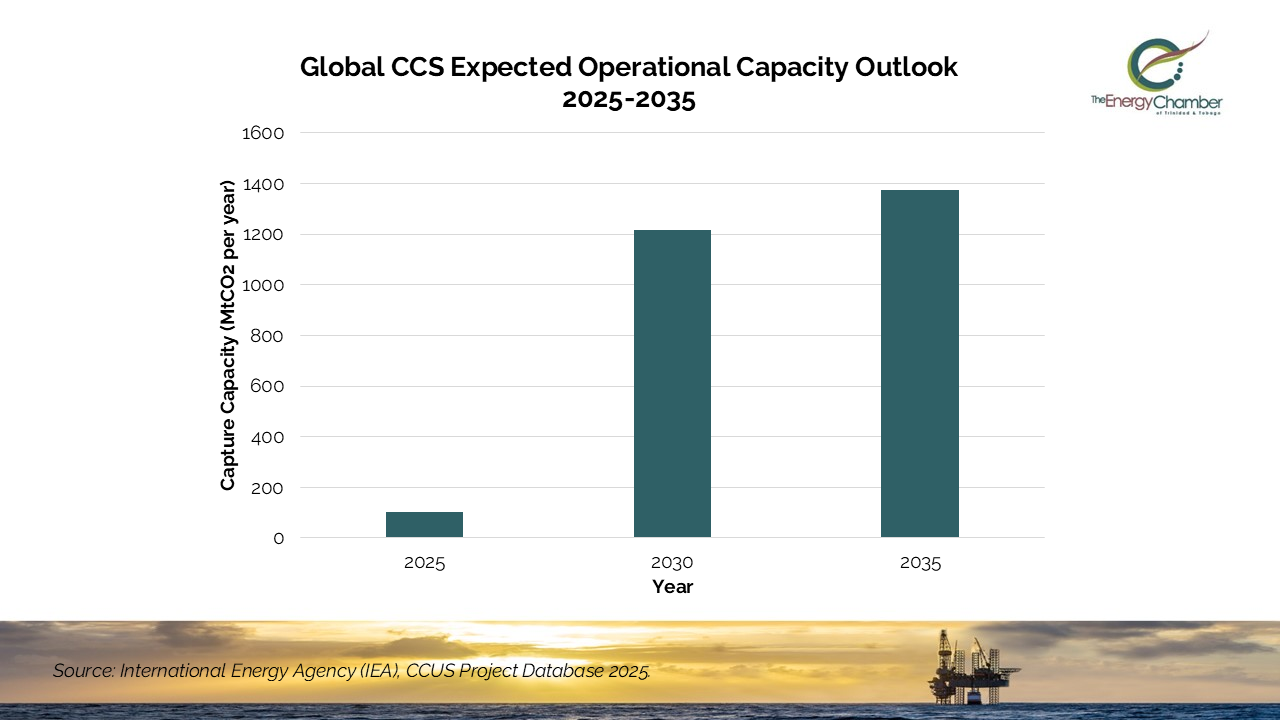
Global carbon capture, utilisation, and storage (CCUS) deployment is projected to expand significantly over the next decade, with the steepest growth expected before 2030. Based on project-level data from the International Energy Agency (IEA) CCUS Projects Database 2025, cumulative operational carbon capture capacity could rise from just over 100 MtCO₂ per year in 2025 to more than 1,200 MtCO₂ per year by 2030, and approximately 1,370 MtCO₂ per year by 2035, assuming currently announced projects come online as scheduled.
This outlook highlights a dramatic acceleration in deployment during the late 2020s. While current operational capacity remains modest, a substantial volume of projects now under construction or in advanced planning stages target start-up before 2030. If realized, this would represent more than a tenfold increase in global capture capacity within five years. The projected jump between 2025 and 2030 reflects the maturation of projects that have moved beyond early announcement stages. In recent years, stronger policy support in jurisdictions such as the United States and parts of Europe has improved project economics and investor confidence. Fiscal incentives, carbon pricing frameworks, and industrial decarbonisation funding programmes have helped push several large-scale projects toward final investment decisions.
However, it is important to note that this outlook reflects expected operation dates reported at the project level. Historically, not all planned projects reach completion on schedule. Financing constraints, permitting timelines, infrastructure bottlenecks, and regulatory uncertainty can delay or reduce realised capacity. As such, these figures represent pipeline potential rather than guaranteed deployment. Even with that caveat, the scale of planned implementation indicates that CCUS is moving from demonstration scale toward mainstream industrial deployment.
The projected expansion of carbon capture capacity aligns with broader global decarbonisation strategies. Heavy industry sectors, including cement, steel, chemicals, and hydrogen production, increasingly view CCUS as a critical pathway for reducing process emissions that are otherwise difficult to eliminate. CCS is widely regarded as a technically viable and necessary transition technology, particularly for CO₂-intensive developing economies that must balance emissions reductions with continued industrial growth. As major economies tighten carbon accounting standards and introduce mechanisms such as the European Union’s Carbon Border Adjustment Mechanism (CBAM), the carbon intensity of industrial output is likely to play a larger role in determining market access and cost competitiveness.
For Trinidad and Tobago, the projected global acceleration in CCUS deployment has clear strategic relevance. The country’s downstream sector, including ammonia, methanol, and LNG production, is deeply integrated into international markets and remains heavily dependent on natural gas. Carbon capture offers one pathway to reduce lifecycle emissions associated with gas-based industrial production. Integrating CCUS into ammonia or methanol facilities could lower embedded emissions and help maintain export competitiveness as carbon accounting standards tighten.
Beyond capture at industrial facilities, Trinidad and Tobago is also advancing research into long-term geological storage. As noted by Dr. Lorraine Sobers, Lecturer in the Department of Chemical Engineering at The University of the West Indies and Fellow of the Caribbean Policy Consortium, CCS represents a technically viable and necessary transition technology for industrial economies such as Trinidad and Tobago. She emphasises that targeted research is essential to address safety and security questions related to CO₂ storage in the specific subsurface formations being considered locally.
According to Professor Raffie Hosein and Professor David Alexander, an ongoing project is currently examining the potential for carbon storage in deep saline aquifers. This initiative is supported by the Green Climate Fund and represents a collaborative effort between the University of Trinidad and Tobago (led by Professor Donnie Boodlal), The University of the West Indies, and the University of Texas at Austin. While detailed findings remain confidential, the project underscores growing institutional capacity in carbon storage assessment and signals international confidence in Trinidad and Tobago’s geological potential. The country was among the first to secure Green Climate Fund support specifically for carbon capture and storage-related assessment work, positioning it at the forefront of regional CCUS research.
This work complements ongoing efforts between the two institutions, supported by the Ministry of Energy and Energy Industries, in the development of a national Carbon Storage Atlas, which identifies depleted oil and gas reservoirs with potential storage capacity. Together, these efforts strengthen the technical foundation required for future policy and commercial development. In parallel, low-carbon development strategies can position Trinidad and Tobago to continue leveraging the technical capacity, infrastructure, and economic advancement fostered by its energy sector over more than a century.
Rather than representing a departure from its industrial base, CCUS may serve as an evolution of that expertise into emerging carbon management markets. At the same time, CCUS opportunities extend beyond storage. In an OilNOW analysis titled “Out of Thin Air: Opportunities in Industrial Low Carbon Development,” Dr. Lorraine Sobers emphasised that industrial CO₂ can be reframed as a resource rather than simply a waste stream. Utilisation pathways, alongside storage, could support industrial diversification and value creation within low-carbon development strategies. For Trinidad and Tobago, monitoring this trajectory is essential; early engagement in regulatory design and downstream integration strategies could allow the country to position itself effectively alongside international trends.