Trinidad and Tobago’s natural gas sector could receive a meaningful boost from 2027 as regional cooperation gains momentum and a new wave of upstream projects led by bp and Shell moves towards first gas. These developments are expected to provide welcome relief to the downstream sector and improve feedgas availability for LNG operations. While they may not fully close the country’s supply gap, they create a stronger platform for growth and reinforce the importance of cross-border gas as part of a longer-term solution.
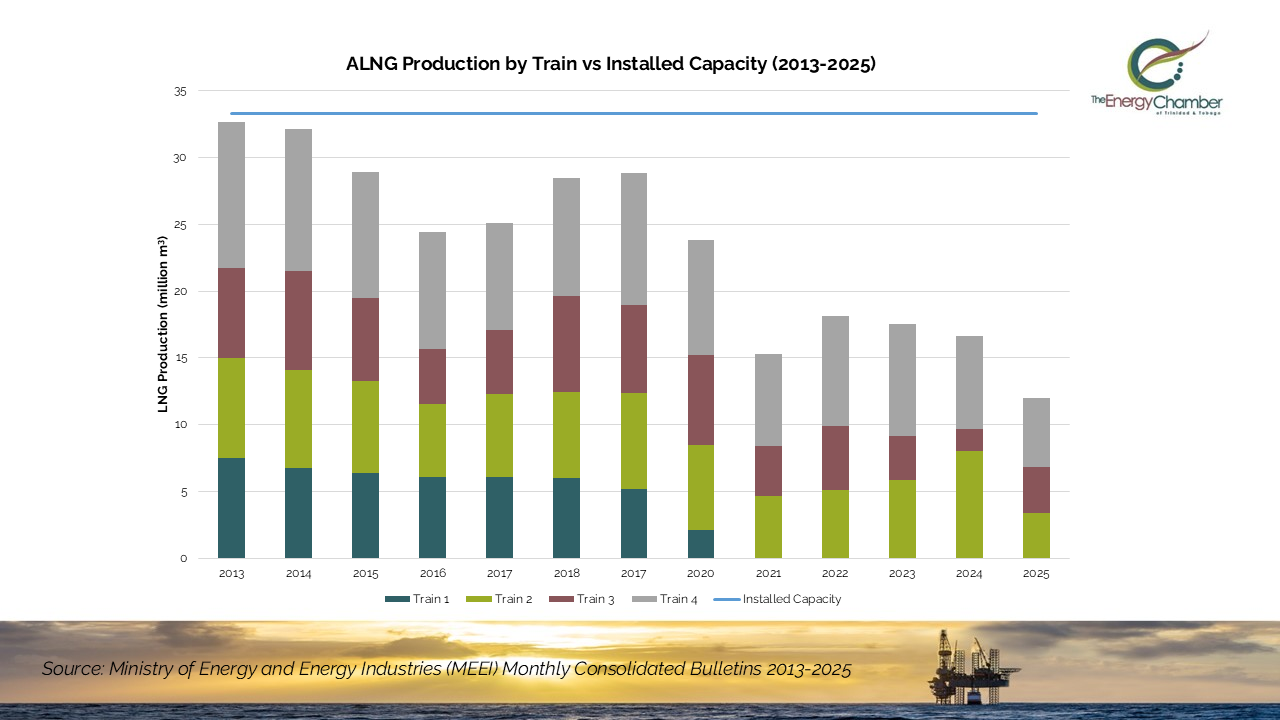
Atlantic LNG has operated below its installed capacity of 33 million cubic metres in recent years as feedgas shortages reduced utilisation and contributed to the shutdown of Train 1 in 2020. But that spare capacity also highlights the upside available to Trinidad and Tobago as new gas volumes come into the system and existing infrastructure can be put to fuller use.
The chart shows the extent of available upside in the LNG sector. Rystad Energy estimates that Trinidad and Tobago’s gas production declined by about 15% between 2020 and 2025, while LNG has increasingly absorbed much of the upstream shortfall, with its share of gas utilisation falling from around 55% in 2016–2020 to about 45% from 2021 onward. In effect, LNG has served as the balancing segment in the gas market, which means that stronger feedgas availability could translate directly into improved utilisation and export performance.
There is already a strong near-term recovery story. Bp’s Ginger development and Juniper Wells infill programme are expected to deliver first gas in 2027, while Shell’s Manatee and Aphrodite developments are also targeted for first gas in that period. The same report notes that Mento has already delivered first gas, Cypre began production in 2025, and Coconut is expected to start up in 2027. Together, these projects point to a noticeable rebound in production over the next few years and should provide welcome relief to domestic feedgas constraints and the downstream sector.
That expected uplift is important because it gives Trinidad and Tobago a stronger platform from which to build. Rystad projects that projects currently under development should help support supply into the early-to-mid 2030s. While a longer-term gap may still need to be addressed beyond that period, the upcoming wave of production creates a window of opportunity for the country to strengthen LNG utilisation, support petrochemical output and position itself for the next phase of supply development.
That is where cross-border gas becomes increasingly important. Rather than simply filling a shortfall, Venezuelan gas can be seen as a strategic complement to domestic production and a way to extend the life and value of Trinidad and Tobago’s LNG and petrochemical industries. Rystad describes Venezuelan gas as the most credible long-term stabiliser because of its proximity to Trinidad’s eastern offshore acreage, pipeline network, and existing industrial infrastructure. Shorter tie-back distances, lower capital intensity, and faster development timelines make cross-border volumes more practical than many deepwater or greenfield alternatives. In that context, projects such as Dragon and Loran could help support fuller use of existing infrastructure and reinforce Trinidad and Tobago’s role as a regional gas-processing hub.
Recent developments in Venezuela suggest that progress on those opportunities may be becoming more feasible. Reuters reported in early March that Chevron and Shell were closing in on major new production deals in Venezuela after reforms to the country’s oil law granted foreign firms’ greater autonomy to operate, export, and sell Venezuelan oil. Chevron’s proposed expansion is centred on its Petropiar project and the adjacent Ayacucho 8 area, while Shell signed agreements covering offshore gas as well as onshore oil and gas opportunities. Reuters also reported that Shell’s plans include opportunities tied to gas capture, processing and transport that could potentially support export routes through Trinidad and Tobago.
Chevron’s activities can be viewed as a constructive signal rather than an immediate solution. Reuters later reported that Chevron CEO Mike Wirth said more legal and fiscal changes are still needed in Venezuela to encourage investment at the scale companies would want, including tighter rules, clearer incentives, and access to international arbitration. Even so, the recent increase in activity is an encouraging sign that the investment environment may be moving in a more workable direction.
For Trinidad and Tobago, the significance is broader than Chevron’s oil position alone. Energy Minister Roodal Moonilal said in March that Chevron had reached out for discussions on cooperation in the energy sector, “not just exploration and production, but some matters pertaining to storage,” and that he had previously discussed using Trinidad and Tobago as a hub for shipments of oil from Venezuela. In the same interview, Moonilal also said the closure of the refinery had forced Trinidad and Tobago to buy liquid fuels and that a working Guaracara refinery would have been a “true windfall” in the current price environment. Taken together, those remarks point to a more active regional energy environment in which Venezuela’s oil and gas infrastructure, Trinidad and Tobago’s industrial base, and potential cross-border projects could become more intricately linked over time.
Overall, a combination of new domestic gas projects, cross-border supply opportunities and renewed upstream activity in Venezuela could help Trinidad and Tobago improve LNG utilisation, support downstream industries, and strengthen its position as a key energy hub in the Caribbean.