At approximately 11.25 a.m. yesterday (Thursday December 20, 2018), Heritage Petroleum’s HSE department received reports of oil having been sighted in the vicinity between RP1 and Platform 9, Soldado Main Field. The Company’s Oil Spill Contingency Plan was immediately activated and the relevant personnel were dispatched to the scene.
The Safe TO Work Implementation Board wishes to remind all contractors and operators that the recommended colour for certification of slings for the next period i.e. January 1st – June 30th 2019 is Orange. The recommended colours and the relevant time periods are indicated below. This colour pattern will repeat for subsequent two year periods.
Sustainable development refers to a process of thoughtful growth that enables societies to meet their needs today without jeopardising the viability of future generations. The global compact to grow by this principle is elaborated in 17 sustainable development goals (SDGs) that have been set and agreed by members of the United Nations General Assembly. These SDGs are targets for nations to meet by 2030 that tackle a broad range of development issues, such as poverty, hunger, health, education, climate change, gender equality, water, sanitation, energy, urban growth and social justice.
The contract itself may not set the pulse racing: La Brea’s Tofco has been given the go ahead to build the jacket for bpTT’s Cassia C offshore development – a welcome but much smaller contract than the Juniper project a few years ago, when both the jacket and the topside were built in T&T.
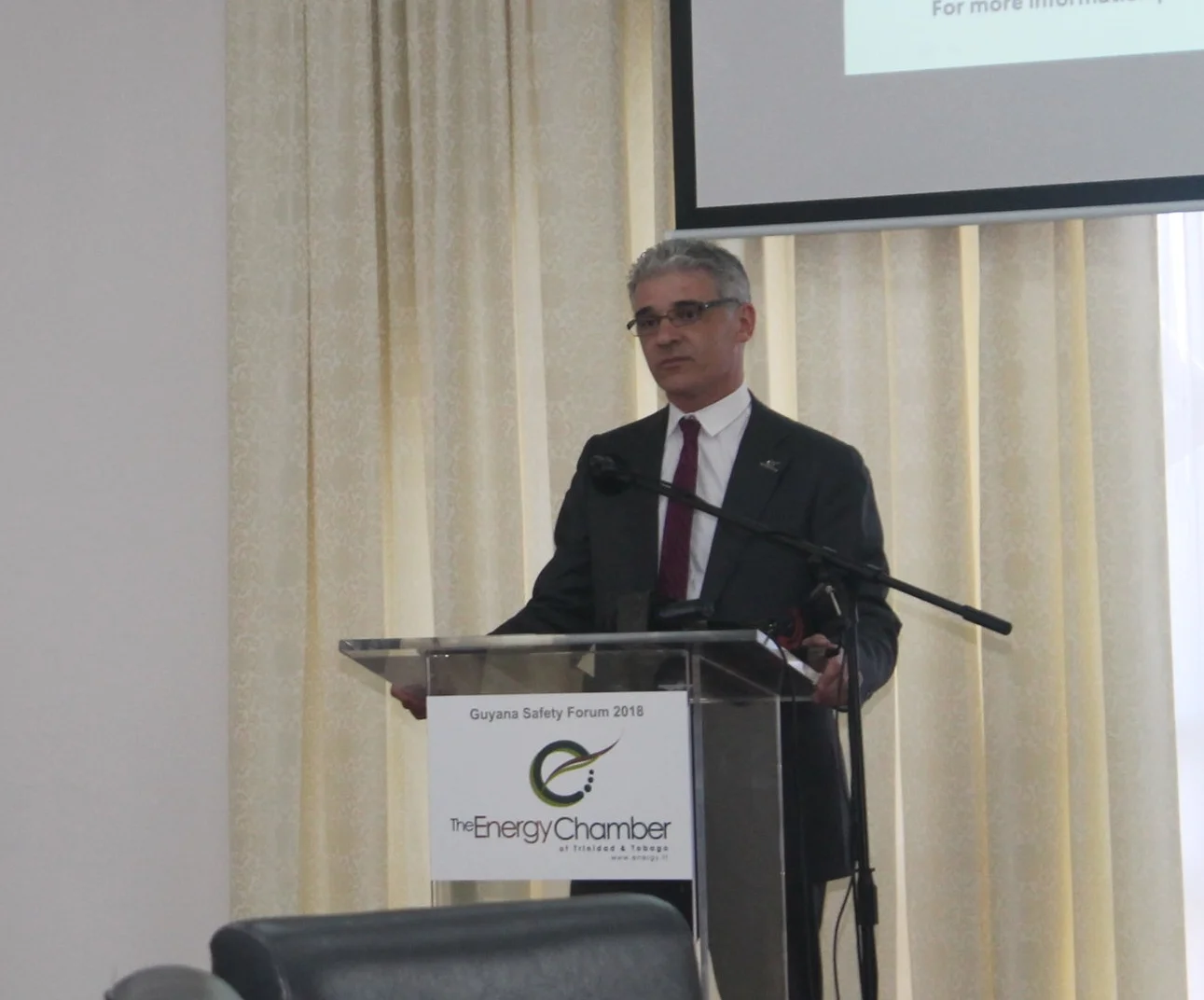
As I am sure that all of us in this room are all too aware, one of the major barriers facing small contractors and service companies wanting to do business with international oil and gas companies is meeting the high safety, health and environmental standards that they demand from all their suppliers.
Jamaica, often regarded for its sun sand and sea, has been undergoing a major shift in Jamaica’s oil and gas exploration since 2006 with the signing of contracts to acquire in the vicinity of 15,000 line kilometres of 2D seismic offshore Jamaica. Once acquired and processed, this updated seismic data allowed for the transition of play concepts found onshore to be mapped and extended into the offshore environs. This evolution of the Jamaican geology generated interest from various operators that derived clastic and carbonate plays offshore being charged by both Cretaceous and Tertiary source rocks.
According to a report in Upstream, U.S. player, Kosmos Energy, has drilled a second duster off Suriname at the Pontoenoe-1 wildcat in Block 42. The well will now be plugged and abandoned, and the well results integrated into the ongoing evaluation of the remaining prospects in Kosmos’ acreage position.
The third drillship contracted by Exxon in Guyana, the Noble Tom Madden has spud Pluma. This represents the 12th well drilled in Guyana by Exxon. Thus far, the company has been successful in nine of those wells.
A joint venture among Guyanese companies, Mines Services Ltd, a member of the Farfan & Mendes group of companies, TOTALTEC; and Trinidad and Tobago energy services company, Process Components Limited (ProCom), has led to the development of a new energy services company, Jaguar Oilfield Services Guyana Inc. (Jaguar).
Touchstone, in their operational update at the end of October, has revealed that they have increased production by 22 per cent, compared to production in Q3 2017.
The first export of crude oil from Petrotrin was loaded onto the tanker, Hellespont Progress, on October 30th 2018 and was delivered to the Caribbean Sea terminal of the trans-Panama pipeline. This suggests the crude was destined for an Asian or US West Coast Refinery. According to a press release from Petrotrin dated November 1st 2018, the tanker was loaded with approximately 500,000 barrels of crude oil which was purchased by Trafigura Oil Traders, one of the world’s major commodity traders. The crude went to Panama, to the port at the Caribbean side of the Trans-Panama Pipeline. The Trans-Panama pipeline links the Caribbean with the Pacific so the crude was probably eventually going to either a West Coast USA refinery or Asia.
In October, the Trinidad and Tobago Cabinet gave the go-ahead for an eight-block bid round which is set to move forward in early November. Six blocks are shallow-water offshore blocks and two are onshore.
The 20th Ministerial Meeting of Gas Exporting Countries was held in Trinidad and Tobago in mid- November and the Ministry of Energy hosted a T&T Gas Symposium which featured a keynote address by the Prime Minister, Dr. the Honourable Keith Rowley.
Technology is changing every sector of the economy, including the energy sector. The examples are endless: new seismic imaging technology is unlocking new reserves and improving recovery, drone technology is revolutionising pipeline and platform inspections, RFID technology is transforming inventory management, and everywhere information technology is fundamentally altering how people work and communicate. All of these technologically driven changes have implications for how people work, the jobs people do and the skills and knowledge companies need. Individuals, companies and countries who manage the changes brought about by new technology will succeed, while those who fail to adapt will be left behind.
Trinidad and Tobago’s gas production is set to record its second year of growth in 2018, after years of falling production post the 2010 peak and hitting a low point of just 3.33 billion cubic feet per day (bcf/d) in 2016. Speaking in Trinidad and Tobago’s Parliament in the debate on the 2018-2019 national budget, Minister of Energy and Energy Industries, Senator the Honourable Franklin Khan, outlined the projected gas production through 2022.
The end was somewhat sad and a bit of an anti-climax.
Today marks the end of Petrotrin’s operations and is an understandably difficult period for all of those affected. Consistent with its commitment, the Company has today disbursed $2.7 billion in exit and other payments to its employees.
One of the major barriers facing small contractors and service companies wanting to do business with international oil and gas companies is meeting the high safety, health and environmental standards that they demand of all their suppliers. If a contractor or service company does not meet the operator’s health, safety and environmental (HSE) requirements, they will not even be able to bid for work. This is a particular challenge in countries with new hydrocarbon industries, such as Guyana, especially if they do not have an existing, well-developed, national legislative framework and a history of a strong safety culture. Operators are not going to lower their standards to accommodate local contractors. And nor should they — we all want people to be safe and healthy, and the environment to be protected.
On Wednesday 21st November, the new upstream player in Trinidad and Tobago, DeNovo delivers first gas from the Iguana field.
On Wednesday 21st November 2018, the Joint Chambers gave three national non-governmental organisations TT$200,000 each, to fund their continued work in flood relief and rebuilding. Cheques were handed to the three organisations in a brief ceremony at First Citizens Bank branch in Gulf City, San Fernando.