
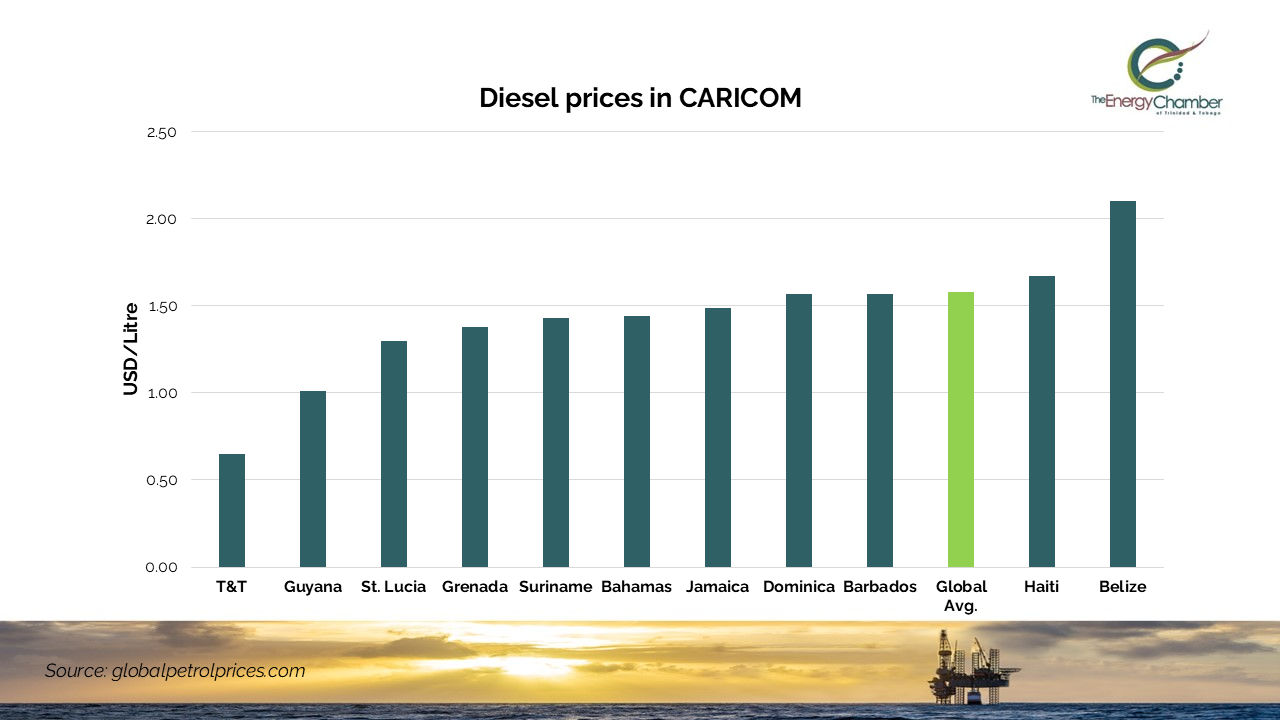
Diesel prices across CARICOM vary significantly, reflecting differences in national fuel pricing frameworks, tax structures, subsidy policies, import costs and domestic market conditions.
Data from GlobalPetrolPrices.com was compiled to show that diesel prices in the CARICOM markets reviewed, ranged from US$0.65 per litre in Trinidad and Tobago to US$2.10 per litre in Belize as of May 11, 2026. The average diesel price across the CARICOM markets reviewed was approximately US$1.42 per litre, below the global average of US$1.58 per litre in the dataset.
Belize recorded the highest price in the sample, while Trinidad and Tobago recorded the lowest. Most of the other CARICOM markets reviewed were concentrated between approximately US$1.30 and US$1.60 per litre, placing them close to, but generally below, the global average.
Diesel in Belize was more than three times the price recorded in Trinidad and Tobago. This gap reflects the varied approaches taken across the region, particularly in relation to taxation, subsidies, regulated pricing and the degree to which international fuel costs pass through to consumers and businesses.
Some countries in the region use subsidies, tax reductions or price caps to reduce the impact of higher fuel costs. Trinidad and Tobago is the clearest example in the dataset. Its diesel price was US$0.65 per litre in May 2026, less than half the CARICOM average and well below the global average. GlobalPetrolPrices.com listed Trinidad and Tobago’s diesel price at US$0.65 per litre, compared with a global average of US$1.58 per litre, highlighting the extent to which domestic pricing policy keeps diesel prices below international levels.
Saint Lucia also provides a direct example of diesel price support. For the April 20 to May 10, 2026 pricing period, the Government of Saint Lucia stated that diesel carried a subsidy of approximately US$0.87 per imperial gallon, equivalent to around US$0.19 per litre, while kerosene and LPG also received subsidies. This shows how targeted fuel subsidies are being used to cushion households and businesses from global oil price volatility.
Guyana has also used tax policy to contain fuel costs. The Guyana Revenue Authority announced in 2022 that the excise tax on gasoline and diesel was reduced from 10% to 0%. The measure followed earlier fuel tax reductions, and was intended to cushion consumers and productive sectors from higher international prices. This helps explain why Guyana remains among the lower-priced CARICOM markets for diesel in the 2026 dataset, at around US$1.01 per litre.
Barbados has taken a different approach, using a wider relief package rather than a diesel subsidy. In the 2026 to 2027 Budget, the Government announced a temporary reduction in the excise tax on diesel from approximately US$0.22 per litre to US$0.17 per litre, while keeping the VAT cap on diesel at approximately US$0.19 per litre until March 31, 2027. The package also included a reduction in the Barbados National Energy Company Limited loss recovery fee from approximately US$0.05 to US$0.02 per litre and a commitment for Government to absorb 50% of the increase in the Fuel Clause Adjustment on electricity bills for three months. PwC reported that these measures were intended to deliver a cumulative reduction of approximately US$0.075 per litre in fuel costs.
These examples show that diesel prices in CARICOM are shaped by more than international oil prices. Some governments absorb part of the cost through subsidies, while others reduce taxes, cap VAT, regulate pump prices or introduce temporary relief packages. These measures help protect consumers and businesses in the short term, especially where diesel is central to transport, construction, shipping and power generation. They also raise fiscal questions, as governments must balance lower pump prices against the cost of maintaining subsidies and tax relief.
Diesel prices are especially important for the Caribbean because diesel is a core input across the wider economy. While gasoline prices are often associated with private vehicle use, diesel has a broader commercial and industrial role. It is used in freight transport, public transportation, fishing, construction, port operations, backup power generation and, in some markets, electricity generation. As a result, diesel prices influence transportation costs, business operations, infrastructure development, supply chains and the delivery of essential services.
This is particularly relevant in small island economies, where goods often move through relatively high-cost supply chains. Higher diesel prices increase the cost of transporting food, fuel, construction materials, equipment and consumer goods from ports to warehouses, supermarkets and project sites. These costs place pressure on businesses and, over time, contribute to higher prices for consumers.
Diesel is also a major cost factor in construction and infrastructure activity. Heavy equipment used in roadworks, quarrying, land development and building projects is often diesel-powered. When diesel prices rise, contractors face higher operating costs, particularly on projects where fuel is a major input. This has implications for both private sector development and public infrastructure programmes across the region.
In several Caribbean markets, diesel and other petroleum products remain important to power generation and energy security. The World Bank has noted that the Caribbean is highly dependent on imported petroleum products for electricity generation, with imports accounting for around 90% of petroleum consumed. It has also stated that 96% of regional power generation relies on diesel-fired plants. This makes diesel pricing important for electricity costs, energy resilience and the wider competitiveness of Caribbean economies.
Hotels, hospitals, telecommunications providers, utilities, ports, manufacturers and commercial buildings also rely on diesel generators during outages, emergencies and periods of grid instability. This gives diesel a strategic role in business continuity and disaster resilience, particularly during the hurricane season.
Maritime transport is another channel through which diesel prices affect regional costs. CARICOM economies depend heavily on shipping to move food, fuel, construction materials, manufactured goods and tourism supplies across and into the region. Diesel-related marine fuels support port operations, inter-island trade, cargo movement and vessel activity. When fuel costs rise, shipping and logistics providers face higher operating expenses, which feed into freight rates and the landed cost of imported goods. For small island economies, where imports account for a large share of consumption and production inputs, this makes diesel pricing relevant to inflation, business competitiveness and the cost of living.
The 2026 diesel price data therefore points to a wider economic issue. Diesel is a key cost input for transport, construction, shipping, electricity resilience and business operations. Countries with lower diesel prices are often using subsidies, fixed pricing or lower tax burdens to cushion consumers and businesses. Countries with higher prices are often passing on more of the full cost of imports, taxes, transport and distribution.
For CARICOM, diesel pricing remains closely linked to competitiveness, energy security and cost of living pressures. The data also underscores the importance of continued investment in renewable energy, grid resilience, public transport, electric mobility and energy efficiency. Reducing dependence on imported diesel and other petroleum products would help limit exposure to global fuel price volatility, while supporting more stable long-term energy costs across the region.