
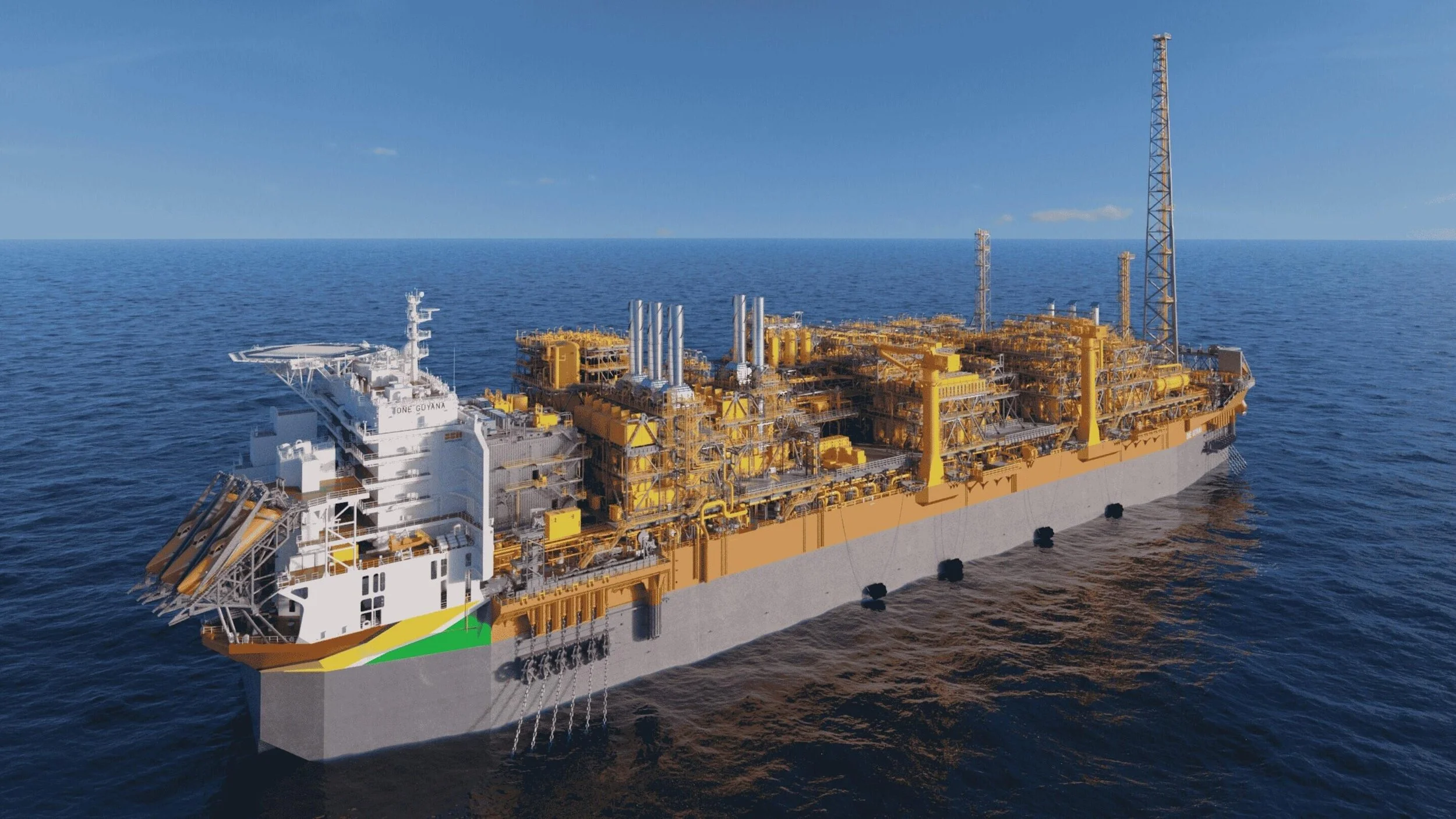
ExxonMobil is using artificial intelligence and high-performance computing to accelerate the analysis of seismic data from Guyana’s offshore oil fields, a development that could further strengthen the country’s position as one of the world’s fastest-growing oil producers.
John Ardill, ExxonMobil’s Vice President of Exploration, said at the Offshore Technology Conference in Houston that new AI-driven tools are helping the company interpret seismic data from Guyana in days rather than months. The technology is being used to process large volumes of subsurface information and identify geological features that may otherwise take significantly longer to evaluate.
The development is significant for Guyana, where ExxonMobil leads the consortium responsible for all current oil and gas production. Since first oil was achieved six years ago, the country’s production has grown to more than 900,000 barrels per day, supported by successive developments in the Stabroek Block.
Artificial intelligence is increasingly being used across the global oil and gas industry to improve exploration workflows, reduce uncertainty and support faster decision-making. In Guyana, where offshore discoveries have transformed the country’s economic outlook, faster seismic interpretation could help operators better assess future drilling prospects and optimise development planning.
According to Reuters, Ardill said ExxonMobil is using deep learning and reinforcement learning to help prioritise geological anomalies. These tools allow the company to sort through complex datasets more efficiently, giving exploration teams a clearer view of where additional opportunities may exist.
The use of AI also has wider regional implications. ExxonMobil has been applying lessons from Guyana to other frontier and deepwater basins, including Trinidad and Tobago. Earlier this year, the company awarded a contract to Shearwater Geoservices for a 3D seismic survey offshore Trinidad and Tobago, covering approximately 6,000 square kilometres in deepwater acreage. That survey is expected to support ExxonMobil’s exploration work in an area located north of Guyana’s prolific Stabroek Block.
For the wider Caribbean energy sector, the growing role of AI and advanced computing highlights the importance of digital capability in future exploration. As regional producers seek to attract investment and improve the competitiveness of their upstream sectors, access to better data, faster interpretation and modern technical workflows could become increasingly important.
Guyana remains central to ExxonMobil’s global portfolio. Reuters reported that the company views Guyana and the Permian Basin as strategically important projects, with breakeven prices below US$30 per barrel. This strengthens Guyana’s role as a competitive source of supply at a time when energy security, investment discipline and production costs remain major considerations for global oil markets.
AI is changing the speed at which companies can evaluate opportunities rather than replacing exploration expertise. For Guyana, that could mean faster technical assessments, more efficient project planning and continued interest in one of the region’s most important offshore energy provinces.