
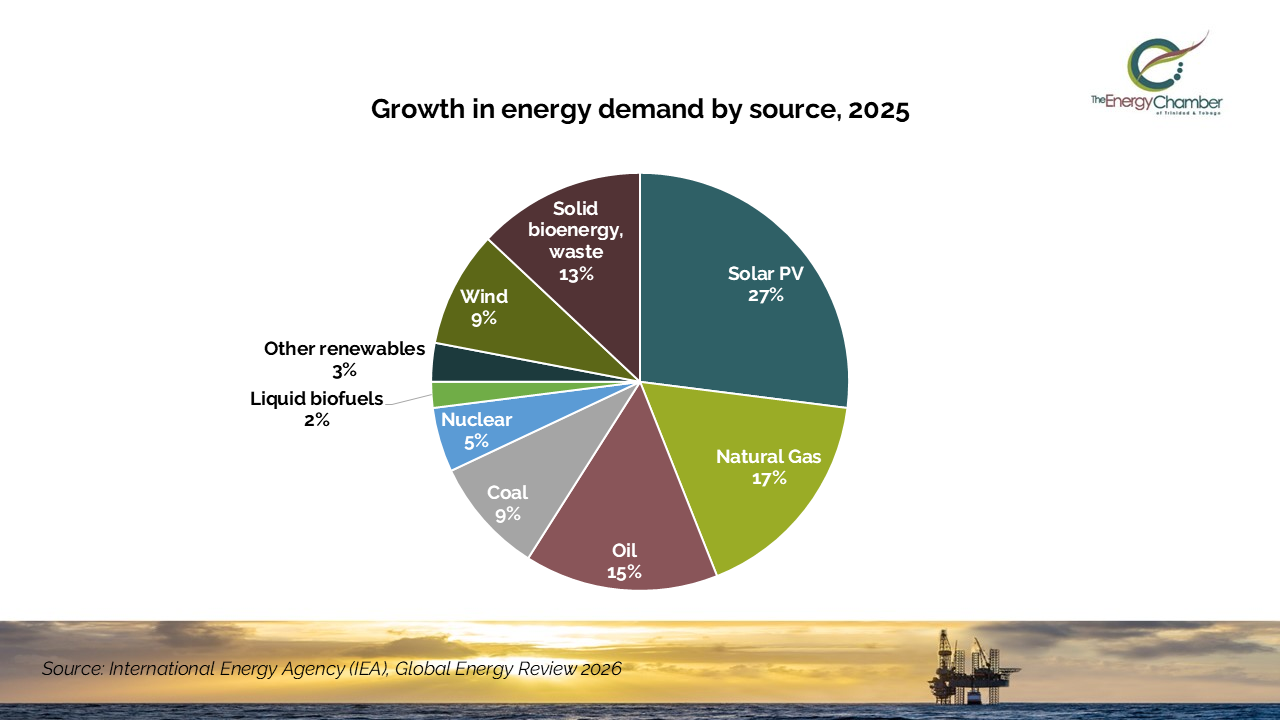
The International Energy Agency’s Global Energy Review 2026 offers a broad snapshot of how the world’s energy system evolved in 2025, and its central message is that demand continued to rise across all major fuels and technologies, though at very different rates. Overall global energy demand increased by 1.3% in 2025, slower than the 2% growth recorded in 2024, as slightly weaker economic expansion, lower cooling demand and faster improvements in energy intensity helped moderate the pace of growth.
What stands out most in this year’s review is the changing composition of that growth. Solar PV was the single largest contributor to higher global energy demand, accounting for more than one-quarter of the increase. According to the IEA, this was the first time on record that a modern renewable source provided the largest share of growth in global energy demand. Natural gas followed, contributing about 17%, while low-emissions sources combined, including solar, wind, nuclear, hydropower and other renewables, accounted for nearly 60% of total demand growth.
The report also reinforces what the IEA describes as the “Age of Electricity.” Global electricity demand rose by around 3% in 2025, growing at more than twice the pace of total energy demand. That increase was driven by a broad mix of end uses, including industry, buildings, household appliances, electric vehicles and data centres. In the United States, data centres accounted for around half of total electricity demand growth, underlining how digital infrastructure is becoming a more visible part of the energy story.
On the supply side, low-emissions generation continued to expand strongly. Global electricity generation increased by more than 850 terawatt-hours in 2025, with renewables accounting for the vast majority of the increase. The IEA says the combined growth in renewables and nuclear exceeded the total rise in electricity generation, meaning fossil fuel generation declined overall. Global coal-fired generation fell by around 0.5%, while renewable generation virtually matched coal-fired generation worldwide in 2025.
Solar PV was again the standout. The report says solar generation rose by about 600 terawatt-hours in 2025, the largest annual increase ever recorded for any electricity source outside post-crisis recovery periods. Battery storage also posted another strong year, with global capacity additions rising by around 40% to almost 110 gigawatts. Nuclear also regained some momentum, with more than 12 gigawatts of new capacity starting construction in 2025.
Fossil fuels still grew in 2025, but more slowly than the year before. Oil demand rose by about 0.65 million barrels per day, below both 2024 growth and the average annual gains seen in the decade before the pandemic. The IEA links that moderation partly to weaker petrochemical feedstock growth, especially in China, and to continued gains in electric vehicle adoption, which helped limit oil demand growth in road transport. Global electric car sales climbed by more than 20% to over 20 million units in 2025, representing around one-quarter of new car sales.
Natural gas demand also remained on an upward path, but at a slower rate. The IEA estimates global gas demand grew by around 1% in 2025, down sharply from 2.8% in 2024, with relatively high prices in the first half of the year weighing on consumption. Coal demand, meanwhile, increased only modestly, rising by around 0.4%.
The emissions picture was somewhat mixed. Global energy-related carbon dioxide emissions rose by around 0.4% in 2025, the slowest rate of increase since 2021, but still reached a new high of nearly 38.4 billion tonnes. Emissions in China declined by around 0.5%, helped by strong low-emissions power growth and weaker output in some energy-intensive industries, while India’s emissions were broadly flat. Advanced economies, however, saw emissions rise by 0.5%, slightly faster than emerging markets and developing economies, due in part to colder weather and higher natural gas prices.
For Trinidad and Tobago, the report’s main takeaway is that the global system is becoming more layered. Gas continued to expand in 2025 and oil demand still increased, but the fastest gains came from solar, electricity, storage and other low-emission sources. For energy producers, that points to continued opportunity, but in a market that is becoming more competitive, more electrified and more diversified. That is likely to remain an important consideration for countries seeking to position themselves in a changing global energy landscape.
At the same time, the report points to a more structural shift in the global energy mix. The IEA estimates that the deployment of solar PV, wind, nuclear, electric vehicles and heat pumps since 2019 is now avoiding 3 billion tonnes of CO2 annually and displacing fossil fuel use on a significant scale. That does not signal the end of hydrocarbons, but it does reinforce that the pace of change in the power sector is accelerating.