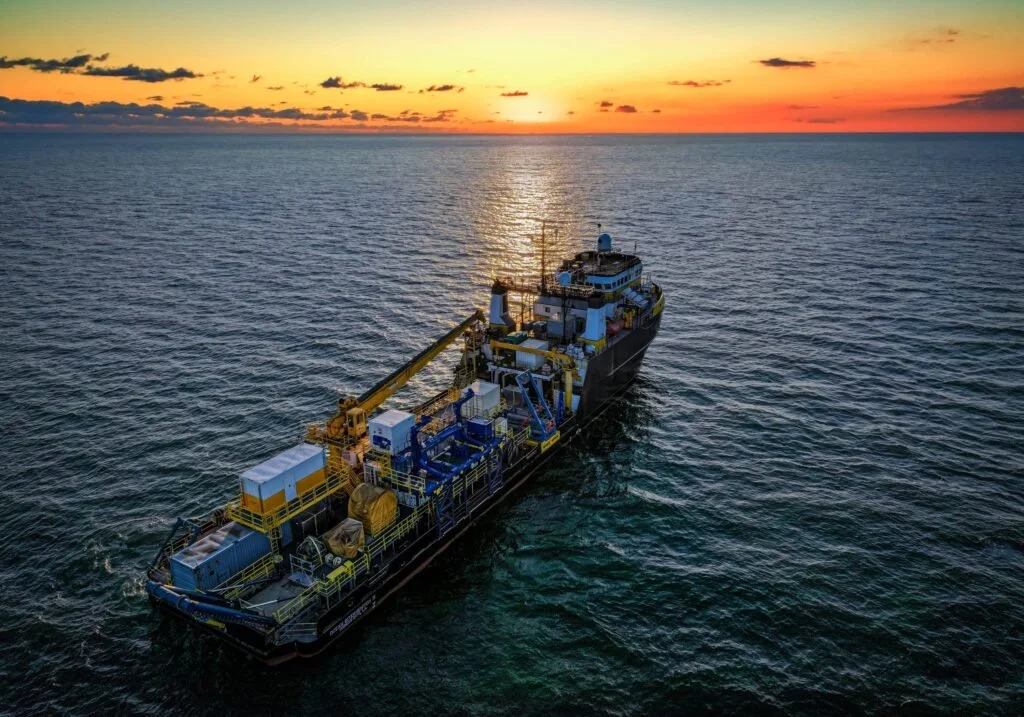
Oceaneering has begun a cross-regional offshore survey programme using its upgraded research vessel, Ocean Intervention II (OI2), under new contracts supporting offshore development projects in Trinidad and the U.S. Gulf.
The company announced that the vessel has been awarded two offshore survey contracts by the same international operator. According to Oceaneering, the programme began in April 2026 and is expected to run for about six months, with options for additional work and contract extensions.
The work offshore Trinidad includes geophysical and geotechnical surveys, high-resolution and ultra-high-resolution seismic acquisition, seabed mapping and sampling, and autonomous underwater vehicle (AUV) surveys in deeper waters. Oceaneering said the scope also includes shallow-water surveys using conventional towed geophysical systems.
In the U.S. Gulf, Ocean Intervention II will carry out geotechnical investigations, AUV-based block surveys and pipeline inspection work. The company said the pipeline inspections will incorporate non-contact cathodic protection measurement technology integrated with the AUV. U.S. Gulf operations are expected to continue for about two months, with options for additional survey work.
Oceaneering said the contracts build on upgrades completed to the 77-metre vessel in 2025. The improvements included expanded survey systems, dedicated launch and recovery capability for autonomous systems, and upgraded data infrastructure designed to support simultaneous multi-discipline survey operations.
Peter Buchanan, Senior Director of Survey, Products and Services within Oceaneering’s Subsea Robotics business, said the upgraded vessel gives the company the ability to collect autonomous underwater vehicle, towed geophysical and geotechnical data simultaneously, improving survey efficiency for offshore projects.
According to Oceaneering, combining multiple survey scopes on a single vessel reduces campaign duration, limits vessel mobilisations and shortens offshore exposure compared with traditional multi-vessel operations. The company added that the approach also helps reduce overall emissions associated with offshore survey campaigns.