
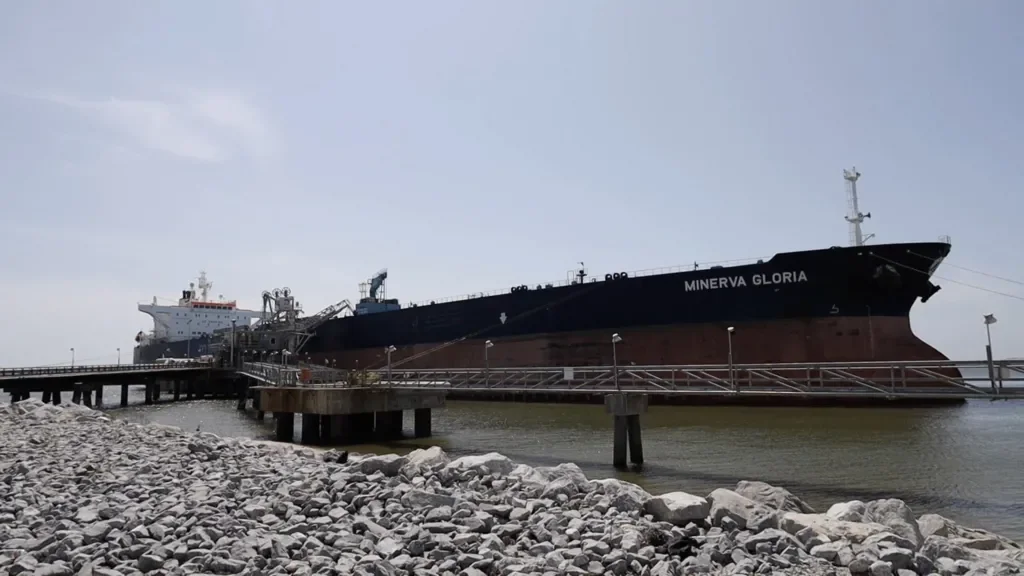
BBC’s report on the arrival of the tanker Minerva Gloria near Chevron’s Pascagoula refinery in Mississippi, carrying 400,000 barrels of Venezuelan crude, may look like a routine refinery story. It is more significant than that. The shipment points to Venezuelan oil moving back into major U.S. refining systems in a way that would have been unthinkable only months ago. We are currently seeing how Venezuela is re-entering regional energy trade in a more practical, commercially visible way.
Venezuelan crude is reappearing in a market that has both the infrastructure and the commercial incentive to run it. Chevron said in January that it was already processing around 50,000 barrels per day of Venezuelan crude at Pascagoula and could take another 100,000 barrels per day across Pascagoula and El Segundo.
Venezuelan barrels are generally heavy, and some U.S. refineries are specifically designed to handle that kind of feedstock. When those supplies return, they do not simply add volume to the market. They can alter refinery runs, affect trade patterns and shift the balance among other heavy crude suppliers. Reuters reported that Chevron’s CEO Mike Wirth said, "As you bring more of these barrels in...they're going to redistribute around the world,” and that a new equilibrium will be established.
The policy backdrop is just as important as the refining angle. Reuters reported in January that Chevron was in talks with the U.S. government over an expanded Venezuela licence that could allow it to restore exports to earlier levels and potentially broaden sales beyond its own refining system. That means the cargo arriving in Mississippi is not just a logistics story. It sits inside a larger process in which U.S. policy is selectively allowing more Venezuelan oil back into legal regional trade channels.
This change is already showing up in the export data. Reuters reported that Venezuela’s crude and fuel exports rose to about 1.09 million barrels per day in March, the first time in six months they had topped 1 million bpd. In the same report, Reuters said Chevron’s shipments increased to 267,000 bpd in March from 209,000 bpd in February. Those numbers do not point to a full sector recovery, but they do show that parts of Venezuela’s oil business are active enough again to influence refiners, traders and neighbouring markets.
At the same time, the recovery remains uneven. Reuters reported on April 8 that Venezuela’s refining network was processing about 399,000 barrels per day, roughly 31% of its installed 1.29 million bpd capacity. So, while exports are improving, the domestic system remains weak. The picture is not one of a restored energy powerhouse. It is one of selective re-entry: exports are recovering faster than the country’s broader refining system.
For Trinidad and Tobago, the significance of this development is that it is a potential option to support the country’s refining ambitions. Our January review of T&T crude imports from Venezuela noted that Trinidad once imported a substantial amount of Venezuelan crude. In fact in 2000, almost half of the crude imported was from imported from Venezuela. Since then there was a decline in imports from Venezuela and an eventual halt in 2009.
Venezuela crude moving once again into legitimate export channels suggests that a potential feedstock source for regional refineries is becoming more commercially accessible. That matters as Trinidad considers restarting the Guaracara refinery, which will depend on a mix of domestic and imported crude, with Venezuelan barrels among the options that can potentially be considered.
Venezuela’s own refining system remains under recovery and access to its crude is still shaped by US licensing and commercial negotiations. However, the return of Venezuelan barrels to major refineries in the United States is a reminder that the regional oil map is shifting again. For Trinidad and Tobago the question is less about this one cargo and more about whether a changing Venezuela oil market could once again matter to the economics of refining closer to home.