
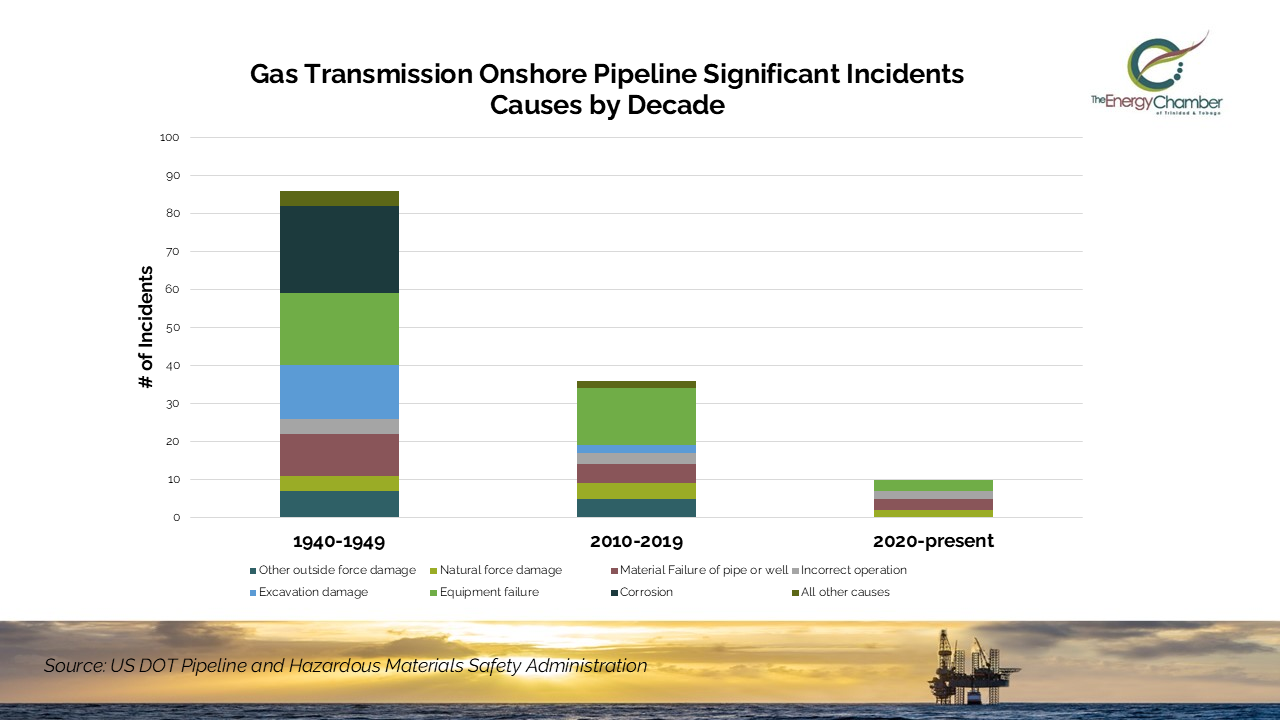
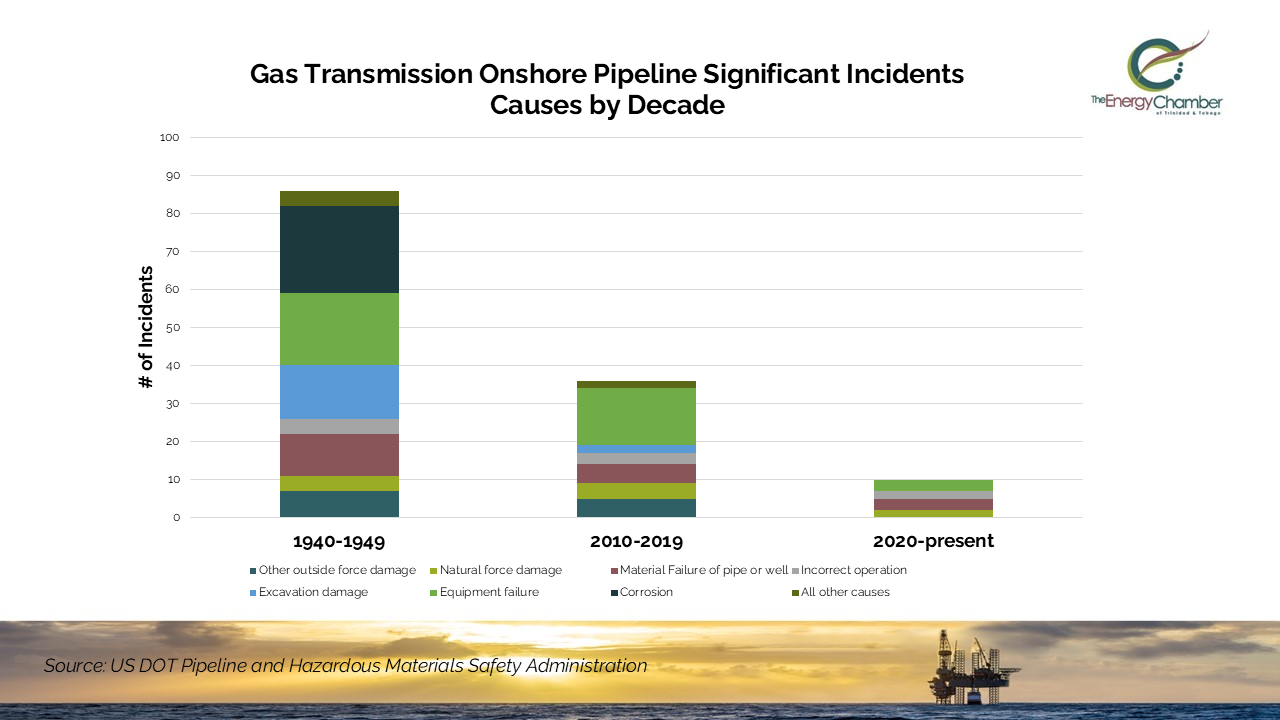
The most useful thing about gas transmission incident data is not simply whether the total number of incidents is rising or falling; it is what the data reveals about the causes of those incidents. The US Department of Transportation Pipeline and Hazardous Materials Safety Administration (PHMSA) chart on onshore gas transmission pipeline significant incidents, shows that the largest contribution in 2010–2019 came from equipment failure, with smaller but notable contributions from material failure of pipe or wells, other outside-force damage, natural-force damage, incorrect operation, and excavation damage.
In the 2020–present period, totals are lower overall, but incidents remain concentrated in a few categories, led by equipment failure, material failure, natural-force damage, and incorrect operation. The message is not simply that incidents have declined, but that those which remain, are still driven by a recognizable set of operational and integrity-related causes. This serves as an important reminder that pipeline safety is rarely about a single hazard. Even when overall totals decline, incidents tend to cluster around recurring causes. In this case, the data suggests that the risk profile is still shaped by a mix of mechanical reliability, asset condition, and operational discipline.
PHMSA’s own framework supports this perspective. On its integrity management overview page, the agency describes integrity management as “a risk-based approach to improving pipeline safety.” This phrase is pertinent because it shows that pipeline safety is not meant to be measured only by broad headline totals; it must be understood through the specific threats behind those totals. That logic runs through PHMSA’s gas transmission integrity management system. The agency’s fact sheet states that the objective is to improve pipeline safety through faster integrity assessments, stronger company integrity management systems, and increased assurance. Its FAQs also note that acceptable assessment methods include internal inspection, pressure testing, and direct assessment, including methods for external and internal corrosion direct assessment. In other words, the U.S. system is built around identifying and managing specific threats before they lead to failures.
This is what makes the cause-based chart so useful. Each category points to a different lesson. If equipment failure is the largest contributor, the obvious questions relate to the reliability of valves, fittings, compressors, and instrumentation, as well as maintenance routines and replacement planning. If material failure remains significant, the focus shifts toward weld quality, pipe condition, and aging assets. If incorrect operation appears repeatedly, the issue is not just hardware, but human factors, procedures, and supervision. Safety data becomes actionable only when it is broken down by cause, as each cause requires a different preventive response.
This provides a clear lesson for Trinidad and Tobago. The real value of PHMSA’s model is not simply that it collects data, but that it classifies incidents in a way that helps operators and regulators prioritize focus. PHMSA explicitly standardizes categories, such as equipment failure, incorrect operation, and natural-force damage, in its reporting framework. This disaggregation makes it easier to move from statistics to action. This reporting gap is significant because a decline in total incidents does not automatically explain what has improved. It does not show whether gains came from better maintenance, contractor management, or excavation controls.
The takeaway is clear: if equipment failure remains the leading cause in both periods, an improvement in overall totals should not lead to complacency. It suggests that technical reliability remains a core issue. For Trinidad and Tobago, prevention efforts must be tied to what the data says is actually going wrong. This requires stronger cause-specific reporting, better disaggregation by sector, and systematic sharing of lessons learned.
In 2025, the Energy Chamber hosted its annual Process Safety Forum, and one of the major takeaways from that forum was the need for sharing lessons learned. Discussing incidents and the insights gained from them is a powerful tool when looking to reduce incidents across an industry, rather than within a single operator, since commonalities exist across multiple process plants. A mature safety conversation in Trinidad and Tobago should move beyond asking whether accidents are up or down. It should ask what the leading causes are, which risks remain stubborn, and what specific interventions will reduce recurrence. This is the real value of this approach; it turns incident reporting from a scoreboard into a prevention tool.
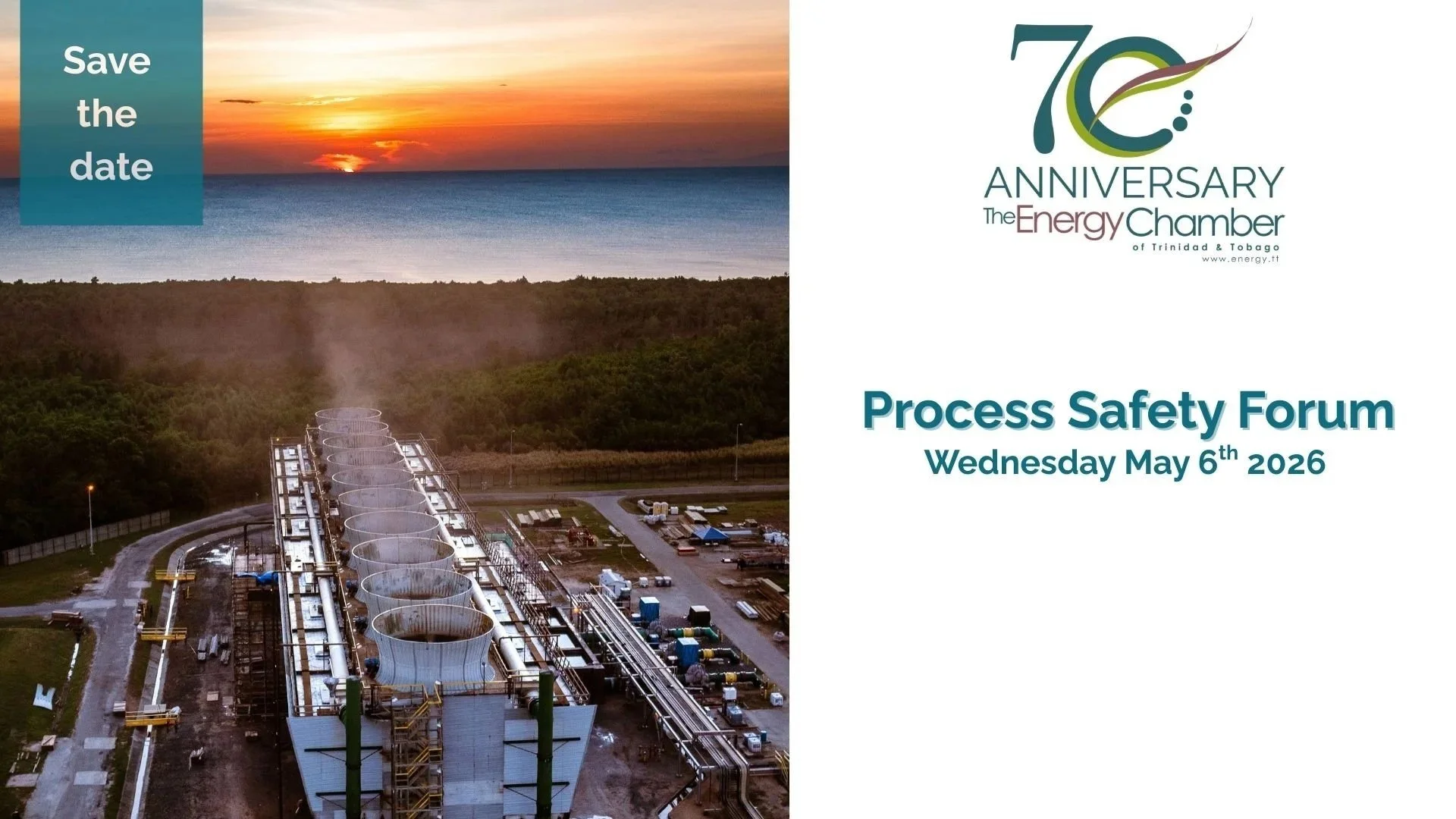
The Energy Chamber will host the Process Safety Forum on May 6th, 2026, at the Cara Suites Hotel and Conference Centre. At this forum, we will examine cutting-edge insights, best practices, and innovative solutions aimed at safeguarding operations, protecting assets, and ensuring the well-being of personnel in the energy sector. We look forward to collaboration within the industry to reduce process safety incidents to zero.
Click to register