
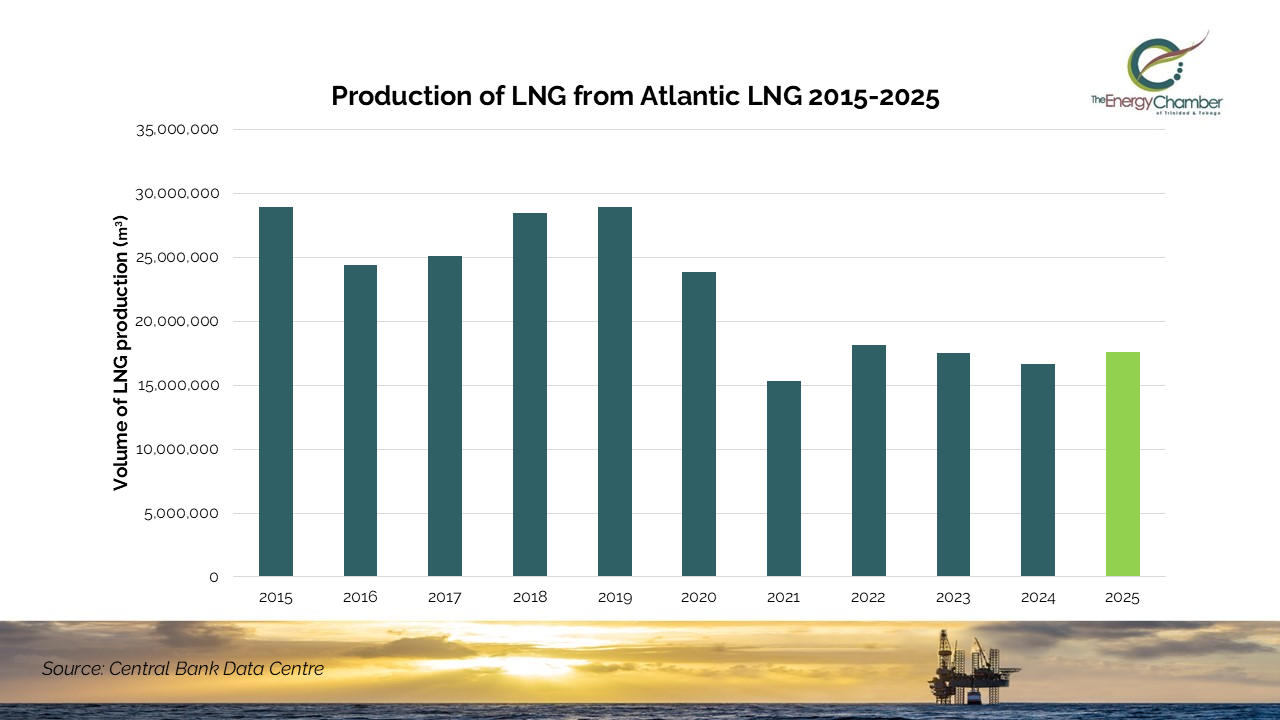
Data from the Ministry of Energy and Energy Industries’ Consolidated Monthly Bulletins and Central Bank Data Centre, show production of LNG from Atlantic LNG rising to 17,594,130 cubic metres in 2025, up from 16,634,427 cubic metres in 2024.
That represents an increase of approximately 5.8% year-on-year, making 2025 the first annual increase since 2022. While production remains below the higher levels recorded before 2020, the latest data points to a measure of stabilization after several years of constrained output.
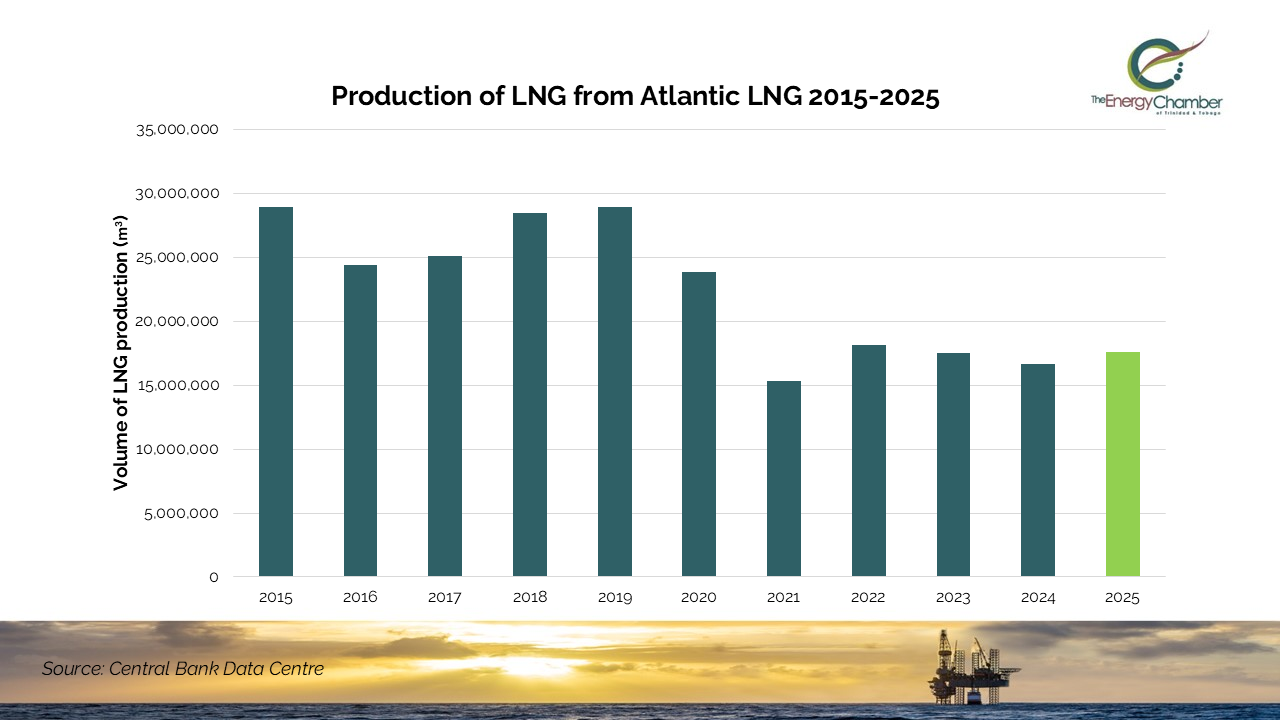
The chart shows that LNG production from Atlantic LNG stood at 28,909,491 cubic metres in 2015, before fluctuating through the second half of the decade. Output remained above 28 million cubic metres in both 2018 and 2019, before falling sharply in 2020 and reaching a low of 15,290,110 cubic metres in 2021. The decline also coincided with the shutdown of Atlantic LNG’s Train 1 in 2020, which was mothballed due to insufficient gas supply.
Reuters reported in January 2026 that Atlantic LNG’s shareholders have agreed to decommission Train 1 because of gas shortages and its lower efficiency compared to the facility’s four liquefaction trains. Since then, production has stayed above that low point, with the 2025 figure showing a clear improvement over the previous year.
The increase is significant because Atlantic LNG remains one of Trinidad and Tobago’s most important pieces of energy infrastructure. The facility gives the country an established route to monetize natural gas, and its existing capacity means there is room for upside as additional gas becomes available.
This is also taking place against the backdrop of a reset in the country’s LNG framework. The restructuring of Atlantic LNG introduced a new unitized commercial structure for the facility, following years of negotiations among the Government, bp, Shell and NGC. bp said the new structure is intended to support improved operational efficiency and reliability at Atlantic LNG.
There are already signs that the commercial reset is improving the value Trinidad and Tobago receives from LNG. Reuters reported in 2025 that revised LNG contracts had contributed to higher government revenue from LNG sales, with the country seeking to capture stronger value from its LNG exports.
On the production side, the main opportunity remains the strengthening of gas supply. Reuters reported that Atlantic LNG exported around 9 million tonnes of LNG in 2025, below its full 12 million tonnes per annum capacity, due to gas supply constraints. The same report noted that Train 4 is scheduled for a major maintenance shutdown in 2026, while Trains 2 and 3 are expected to continue operating during that period.
The outlook for gas supply has become more active. In a recent address, Minister of Energy and Energy Industries Hon. Dr Roodal Moonilal said, “We have stabilized gas production after years of decline and we have arrested that decline and today we have placed the gas sector on a phenomenal growth path.” He indicated that major gas projects are being developed. He mentioned Manatee Plus, Onyx, Coconut and Ginger.
Among the near-term developments, bpTT’s Cypre Phase 1 came onstream in 2025 with peak production of 350 million standard cubic feet per day, followed by first gas from Mento, a bpTT and EOG Resources joint venture, which is expected to produce 250 million standard cubic feet per day at peak. bpTT’s Ginger project and the bpTT/EOG Coconut project are expected to come onstream in 2027.
Shell’s Aphrodite project is another important part of the supply outlook. The project is expected to begin production in 2027, with projected peak output of 107 million standard cubic feet per day, or around 18,400 barrels of oil equivalent per day. Reuters has reported that Aphrodite is expected to help address gas shortages affecting Atlantic LNG.
The Manatee development is the largest of the named projects and remains central to the medium-term outlook. Shell took a final investment decision on the Manatee gas field in 2024, with the project expected to deliver first gas in 2027 and produce 1bcf of gas per day, which is a revised output, up from 600 mmscf/day.
Other projects could add further upside. Perenco’s Onyx gas field is under review following a successful appraisal in the first quarter of 2025, while Woodside’s deepwater project, with gas reserves estimated at 3.5 trillion cubic feet, is projected to add significant domestic gas production.
For Trinidad and Tobago, the 2025 LNG production increase is therefore more than a statistical improvement. It comes at a time when the country is working to improve commercial returns from LNG, preserve the reliability of existing infrastructure, and bring new gas into the system.
The sector still faces challenges, particularly around feedgas availability and natural decline from mature reservoirs. However, the latest data provides a cautiously optimistic signal. With LNG production rising in 2025, Atlantic LNG’s commercial structure reset, and several gas projects advancing, Trinidad and Tobago’s LNG industry appears to be moving into a period of renewed momentum.